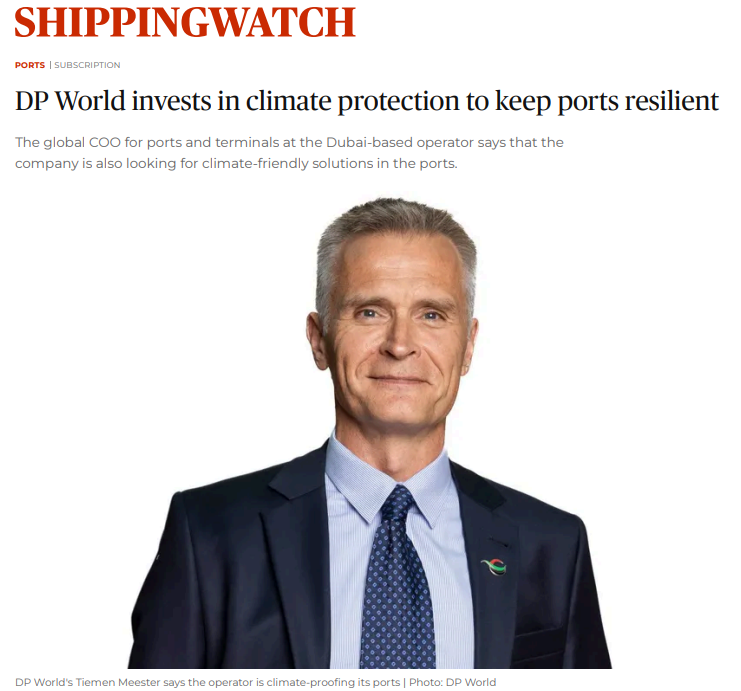
As climate risks escalate across global coastlines, new ShippingWatch reporting reveals just how urgently port operators must act to safeguard infrastructure, trade flows, and coastal communities. The article – “DP World invests in climate protection to keep ports resilient” – highlights DP World’s significant investments to “climate-proof” its 60+ ports and terminals worldwide, underscoring an industrywide shift toward resilience and decarbonization.
For the Americas — home to hurricane-exposed coastlines, rising sea levels, and densely interconnected trade routes — the implications are especially profound.
DP World’s Resilience Strategy Reflects Rising Climate Threats
The article cites a major risk assessment showing that nearly 90% of the world’s major ports are exposed to damaging climate risks, including storm surges, flooding, and extreme heat. With billions in infrastructure and trillions in trade at stake, inaction could lead to soaring repair costs and prolonged supply chain disruption.
This reality aligns with what supply chain stakeholders across the Americas are already experiencing: climate volatility is now a structural operating condition.
DP World’s global COO for Ports & Terminals, Tiemen Meester, explains that the company has conducted detailed climate modeling across more than 50 sites, evaluating sea-level rise, storm intensity, and heat impacts. While many DP World assets are inherently resilient by design, he emphasizes that proactive adaptation — such as strengthening quay walls, electrifying equipment, and deploying renewable energy — is essential for long-term operability.
The Americas Lens: Why Climate Resilience Matters Even More Here
The Americas face some of the most intense climate-driven disruptions:
- Hurricanes and tropical storms continue to affect trade gateways from Mexico to the U.S. Gulf to the Caribbean.
- El Niño–related flooding and extreme heat have strained port operations in Peru, Ecuador, and Chile.
- Sea-level rise threatens coastal terminals across North America and South America.
DP World’s regional investments directly address these escalating risks:
- Peru (Callao): A US$66 million investment in electric cranes and EV infrastructure boosts both climate resilience and air quality.
- Canada: Shore power in Vancouver and Prince Rupert allows ships to shut off diesel engines while berthed — cutting emissions and reducing local pollution.
- Dominican Republic: Fully electric fleets and solar capacity strengthen operational continuity amid climate stress.
- Ecuador & Brazil: Nature-based solutions such as mangrove restoration and aquatic fauna monitoring create natural coastal buffers and protect biodiversity.
Decarbonization Is Becoming a Resilience Strategy
As highlighted in the ShippingWatch reporting, DP World is investing US$500 million over five years in decarbonization — including electrification, renewable energy, low-carbon fuels, process modernization, and digitalization. Already, 59% of all electricity across DP World terminals is renewable, with 28 terminals operating on 100% renewable power.
In the Americas, this progress is accelerating:
- Peru’s electric fleet has already eliminated more than 2,400 tons of CO₂ annually.
- Chile, Ecuador, Brazil, and Canada are expanding renewable power, electrified equipment, and zero-waste initiatives to fortify operational resilience.
Why This Matters Now
With global trade projected to double by 2050 and the Americas playing a growing role in nearshoring and regionalized manufacturing, the region’s ports must be prepared to operate under increasingly volatile conditions.
ShippingWatch’s DP World profile underscores that port resilience is emerging as a top economic priority, not a distant sustainability aspiration. DP World’s strategy across the Americas demonstrates what proactive climate protection looks like — and why it is foundational to the future of competitive, reliable trade.
Read the full ShippingWatch article here: “DP World invests in climate protection to keep ports resilient”