Key Points
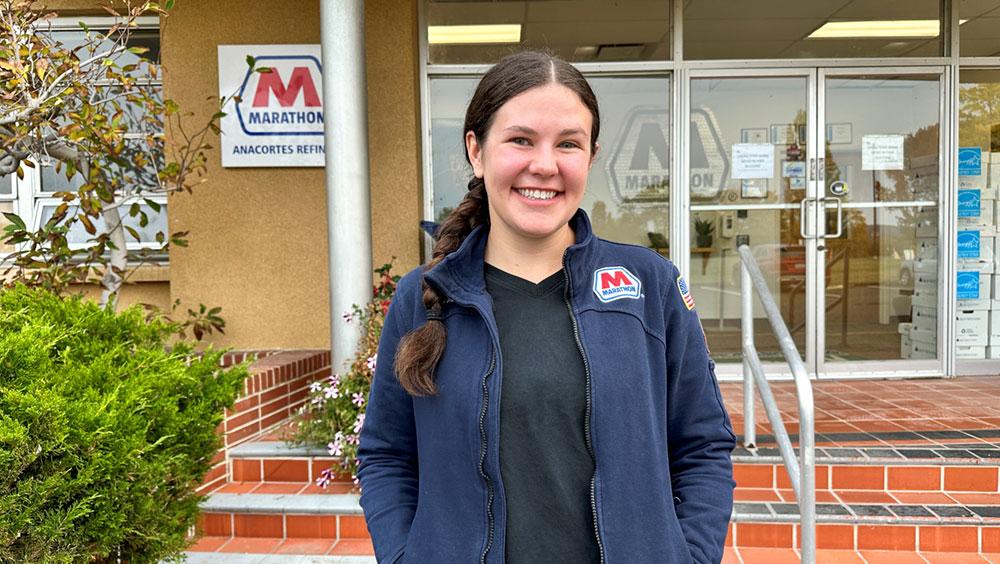
- Amanda Cavazos, a technical services engineer at Marathon Petroleum’s Anacortes refinery, applies a strong chemical engineering and process safety foundation developed through her education and early career experiences.
- Since joining the site in early 2022, she has supported multiple refinery units, optimizing operations and always applying reliability and safety-driven decision making.
- Cavazos shares her expertise through cross-refinery technical meetings, industry conference presentations and community STEM outreach, highlighting the visible impact of engineering work.
At Marathon Petroleum’s Anacortes refinery, Technical Services Engineer Amanda Cavazos has built a reputation for curiosity, adaptability and a deep commitment to process safety, values she says were instilled early in her engineering education at Texas A&M University. Cavazos, who majored in chemical engineering with a safety certificate, credits the program’s strong process safety culture for shaping her career focus.
“Chemical engineering is a mixture of lots of chemistry, physics and math,” she said, describing the combination that drew her into the field.
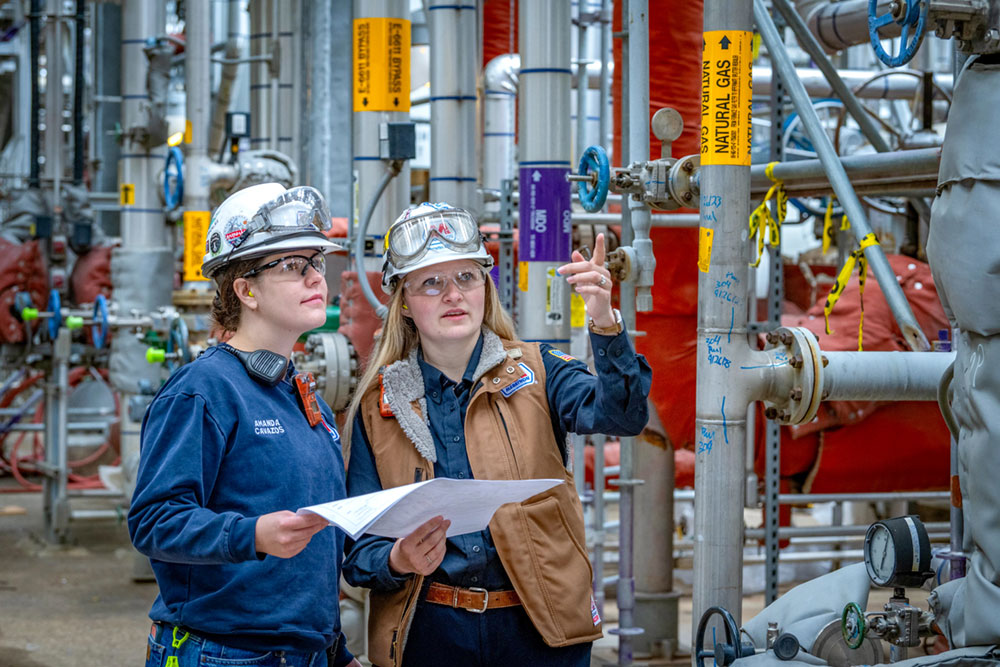
Cavazos and Process Controls Engineer Victoria Henry review a piping and instrumentation diagram in the Catalytic Reformer unit at the Anacortes refinery
Her path to refining started at a college career fair, where an introduction to Marathon Petroleum inspired her to take an internship that changed her trajectory. During a planned maintenance project in her first weeks onsite, she found herself climbing inside crude oil distillation columns, an eye-opening experience.
“That’s when I learned that I really enjoyed it,” said Cavazos. “I love the troubleshooting and the optimization. It’s very pure chemical engineering.”
Building a Foundation
Since joining the Anacortes site in early 2022, Cavazos has worked across several units, starting in the refinery’s utilities systems – boilers, flare, cooling water and air systems that keep the entire operation running.
“Those units lay the foundation for everything at the facility,” said Cavazos. “When there’s an issue, it’s very critical to the refinery.”
She later supported gasoline production units, including the naphtha hydrotreater, isomerization units and catalytic reformer, where she developed a strong appreciation for reaction chemistry and optimization strategies. More recently, Cavazos transitioned to support the crude, vacuum, and residuum oil supercritical extraction (ROSE) units, an area she says requires a different skill set. The work involves heavy oil processing, preventive maintenance and planning for exchanger cleanings. If those cleanings aren’t routine, she explained, refinery capacity and economic performance can suffer.
Cavazos says one of the biggest adjustments from college to the refinery was learning to prioritize amid the constant change of daily operations.
“You have to adjust your priorities based on business needs,” she said. “The fast pace is energizing. Sometimes you can make a big impact when you’re able to shift those priorities to critical business needs.”
Her safety background continues to guide her daily decision making.
“Safety is the highest priority, and it’s very evident from our leadership,” said Cavazos.
Every task begins with the same question: How does this affect safety? The refinery’s investigation process makes sure lessons are captured to prevent repeat incidents. Cavazos says this emphasis resonates deeply with her.
“It’s very important to me personally, and I’m glad the company has an unwavering commitment to safe and reliable operations,” she said.
“Safety is the highest priority…I’m glad the company has an unwavering commitment to safe and reliable operations.”
Sharing Knowledge
Beyond her daily responsibilities, Cavazos participates in Marathon’s face-to-face technical meetings, gatherings that bring engineers and operators from multiple refineries together to exchange ideas, troubleshoot issues and discuss technology. She has attended sessions at Marathon’s refineries in Garyville, Louisiana, and Detroit, Michigan, and values the broad perspective they offer.
Her expertise was also showcased at an American Fuel and Petrochemical Manufacturers (AFPM) conference, where she presented on naphtha hydrotreater fouling mitigation, a technology that has delivered significant benefits to the refinery.
Her manager, Kyle Cassidy, said Cavazos’ strong technical abilities and professionalism have already made a meaningful impact.
“Amanda represented our refinery exceptionally well at AFPM, presenting a complex technical topic with clarity and confidence,” Cassidy said. “She also attended the previous year’s conference as our Emerging Leader candidate, which speaks to the trust and respect she’s earned early in her career. She brings curiosity, discipline and a genuine drive to grow, qualities that make her a standout engineer and a great ambassador for our site.”
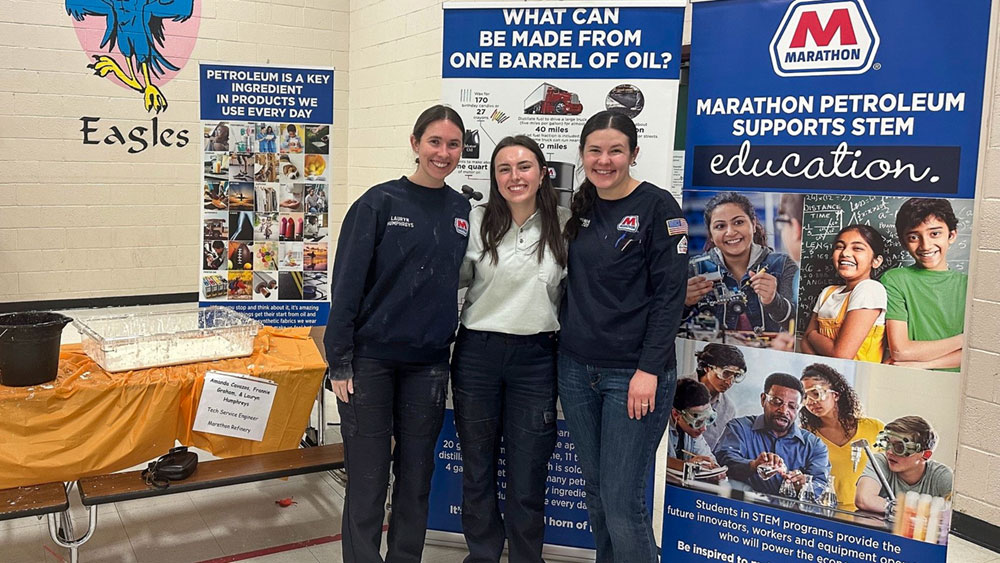
Amanda Cavazos (right) volunteered with Lauryn Humphreys and Elise Conception for the Science at Work Night at Island View Elementary School in Washington. Students explored the wonders of STEM with hands-on demos, including a fun experiment with non-Newtonian fluids by the Marathon Petroleum volunteers.
Inspiring the Next Generation
In the community, Cavazos helps lead the refinery’s participation in the Island View Elementary School science night, an opportunity she calls a way to connect with kids and talk to people in the community who may see the local refineries but don’t really know what they do.
Her advice for young people considering engineering is simple.
“A variety of different experiences is going to help you learn what you really enjoy,” she said. “Stay open to unexpected opportunities.”
Refining, she added, is a career where engineers can clearly see the impact of their work.