Across the Caribbean, a quiet shift is underway. As global trade becomes more regionalized and supply chains more selective, countries are rethinking how they compete – not just as investment destinations, but as reliable participants in global trade.
At the center of this shift is logistics.
Recent analysis from the DP World Effect: Dominican Republic study highlights a growing reality: export competitiveness is no longer driven primarily by incentives. It depends on whether goods can move efficiently, predictably, and at scale.
From Constraint to Competitive Advantage
For decades, many Caribbean economies faced a common challenge: not a lack of production potential, but difficulty connecting that production to global markets.
High transport costs, fragmented shipping routes, and limited service frequency created uncertainty, making it harder for businesses to participate in global value chains. As those barriers begin to ease, the opportunity is not just incremental growth. It is structural.
Efficient logistics systems reduce risk, improve reliability, and shorten time to market. In a nearshoring environment where consistency matters as much as proximity, these factors are becoming decisive.
The Rise of Integrated Trade Ecosystems
What is changing now is not just infrastructure, but how it is used.
Ports, logistics services, and industrial zones are increasingly operating as integrated ecosystems rather than standalone assets. This reduces friction across the supply chain and enables a broader range of companies – including small and mid-sized manufacturers – to participate in export activity.
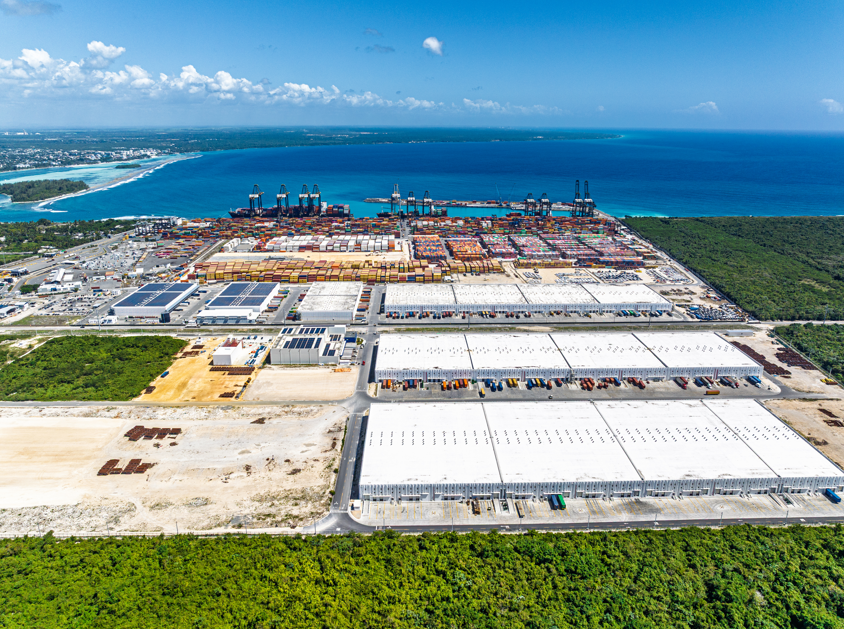
In the Dominican Republic, this model is already taking shape, helping position the country as a more reliable and scalable node in global trade networks. DP World’s integrated port and logistics operations at Caucedo underscore this shift.
Sustainability Is Now Part of the Logistics Equation
As logistics becomes central to economic growth, expectations are also evolving.
Today, competitiveness is not defined solely by cost and speed, it is increasingly shaped by sustainability performance. Global shippers and investors are paying closer attention to how goods move, not just how quickly.
In the Dominican Republic, DP World’s operations illustrate how this shift is playing out in practice, combining operational efficiency with measurable environmental and social impact.
Key initiatives include:
- Electrifying port operations through electric internal transfer vehicles and charging infrastructure
- Generating renewable energy on site through a photovoltaic solar plant
- Advancing mangrove restoration and watershed protection to support climate resilience
- Delivering workforce development, youth training, and micro-entrepreneurship programs
These efforts – along with national recognition for sustainable investment and responsible infrastructure – demonstrate how logistics platforms can deliver both economic performance and long-term sustainability outcomes.
A Regional Inflection Point
The implications extend across the Caribbean.
As nearshoring reshapes global production networks, companies are becoming more selective about where they invest. Proximity alone is no longer enough: locations must offer reliable logistics, integrated infrastructure, and credible progress on sustainability.
For the region, this creates a clear opportunity: to position logistics not just as infrastructure, but as a strategic asset that enables both economic growth and sustainable development.
The Bottom Line
The future of export-led growth in the Caribbean will be determined by logistics capability.
Where systems are connected, efficient, and sustainable, trade can scale. Where they are not, growth will remain constrained regardless of incentives.
As global trade continues to evolve, the countries that invest in resilient, lower-carbon logistics systems will be best positioned to convert nearshoring momentum into long-term, inclusive growth.
Learn more about DP World’s impact in the Dominican Republic