Interview highlights DP World’s long-term commitment to resilient, sustainable trade infrastructure across the Americas
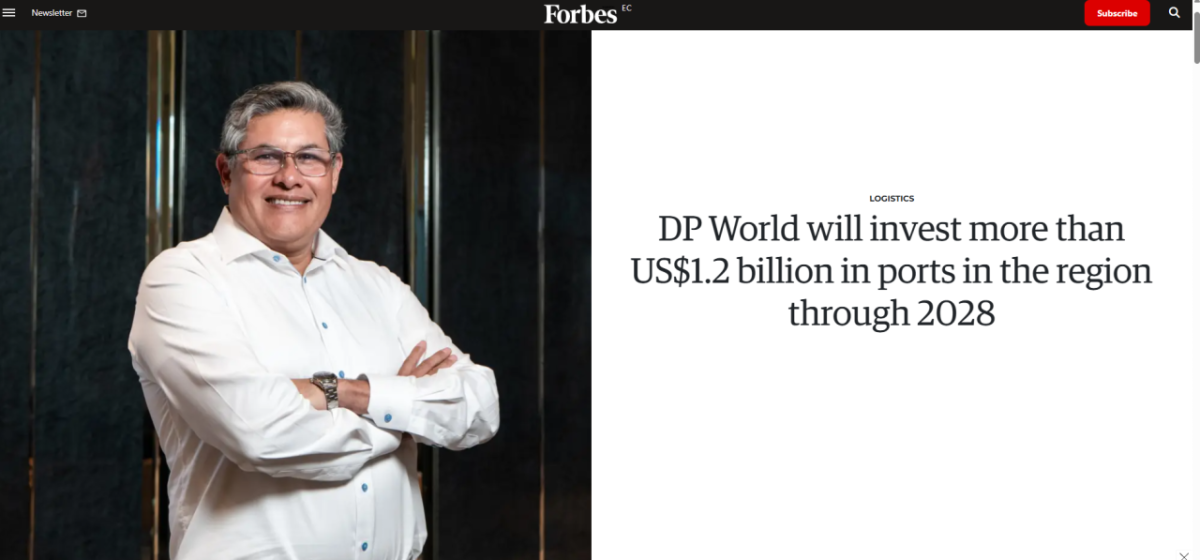
Carlos Merino, CEO of DP World in Colombia, Ecuador, and Peru, was recently interviewed by Forbes Ecuador on the company’s plan to invest more than US $1.2 billion in port and logistics infrastructure across the Americas by 2028.
The article, “DP World will invest more than US$1.2 billion in ports in the region through 2028,” examines how sustained private investment in ports is strengthening regional supply chains, improving competitiveness and supporting long-term economic growth across Latin America.
Investing Ahead of Demand
In the interview, Merino explains that DP World’s investment strategy is designed to anticipate future trade flows rather than react to short-term market shifts. Ongoing investments focus on deep-water capacity, modern terminal infrastructure, and integrated logistics solutions that enable faster, more reliable access to global markets.
Merino notes that ports must be equipped to manage growing cargo volumes while remaining resilient amid geopolitical uncertainty, climate impacts, and evolving customer expectations.
Ecuador and Peru as Strategic Gateways
Forbes Ecuador highlights DP World’s operations in Posorja as a central pillar of this strategy. Since commencing operations, the deep-water terminal has rapidly become Ecuador’s leading port by market share, supported by continuous infrastructure expansion and the ability to handle post-Panamax vessels at full capacity.
The article also points to DP World’s Callao terminal in Peru, where sustained investment has driven record container volumes and strengthened connectivity between the Pacific coast of South America and global trade routes.
Sustainability as a Competitive Advantage
The interview underscores how sustainability is embedded within DP World’s infrastructure investments. From electrified port equipment and renewable energy to digital systems that reduce congestion and emissions, these initiatives are designed to deliver both environmental and operational performance.
According to Merino, sustainability is increasingly a differentiator for ports as customers and partners seek efficient, low-carbon supply-chain solutions.
Ports Powering Regional Growth
As highlighted in the Forbes coverage, DP World’s investment plan reflects the evolving role of ports as engines of economic development – supporting exports, creating jobs, and enabling regional economies to capitalize on nearshoring and shifting global trade patterns.
Merino emphasizes that long-term infrastructure investment will be critical for Latin America to strengthen its position in global trade and build supply chains that are both competitive and resilient.
Read the full Forbes Ecuador interview to learn more about DP World’s regional investment strategy.