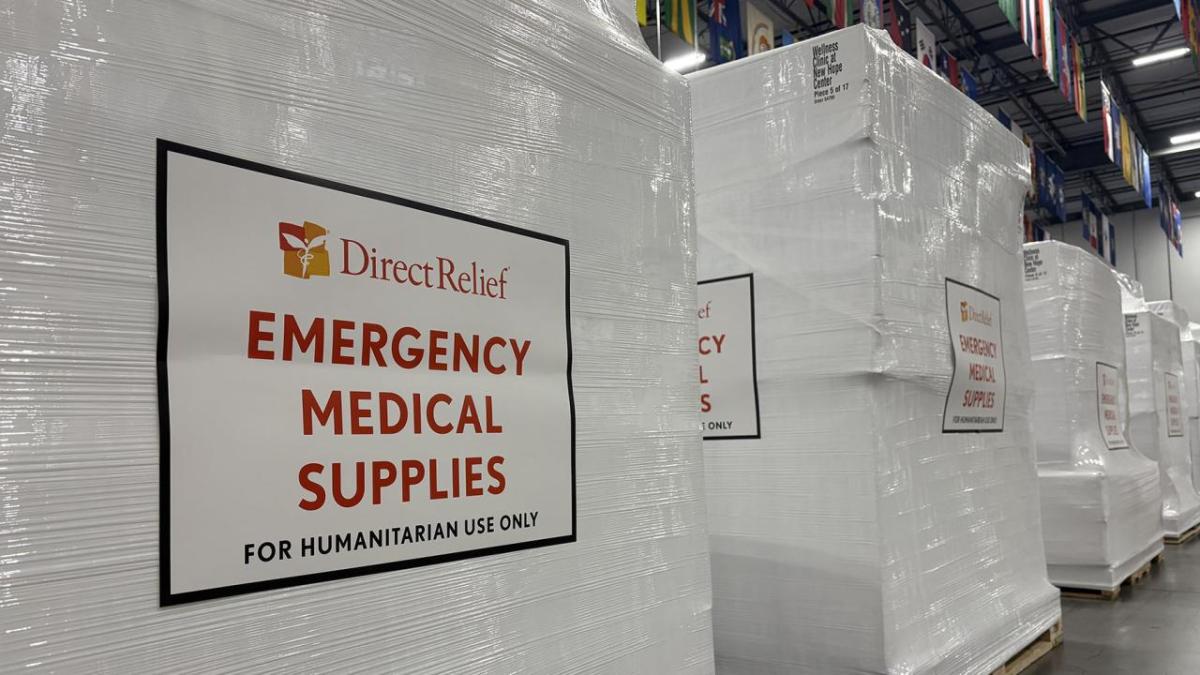
Medical aid prepped for health providers in DRC includes personal protective equipment to prevent disease spread and supportive medications and supplies for patient care.
As a deadly Ebola outbreak spreads in eastern Democratic Republic of Congo, Direct Relief is preparing to ship $2.5 million in medicine and medical supplies to treat patients, protect health workers, and limit the spread of the highly contagious disease.
The outbreak is caused by the Bundibugyo virus, a rare species of Ebola, distinct from the more common Zaire strain. Bundibugyo has a fatality rate of 30% to 50%, according to the World Health Organization.
There is no vaccine for the Bundibugyo virus. Healthcare workers provide patients with supportive care, treating them for dehydration, coinfections, respiratory and digestive complications, and other common symptoms, said Alycia Clark, Direct Relief’s Vice President and Chief Pharmacy Officer.
Direct Relief has been a leading responder to Ebola outbreaks for more than a decade. At the height of the crisis in September 2014, Direct Relief chartered a Boeing 747 that departed New York’s JFK International Airport carrying 100 tons of emergency medical supplies – including 2.8 million gloves, 170,000 coverall gowns, and enough oral rehydration solution to supply two Ebola wards for a full year.
“Direct Relief has longstanding histories with our partners in the affected regions,” Clark said. “These organizations have earned the trust of their communities through years of work under extraordinarily difficult conditions. Direct Relief’s job is to make sure they don’t face this outbreak without the tools to fight it.”
Staff at Direct Relief’s medical warehouse in Santa Barbara, Calif., on Wednesday completed packing the shipment, which includes:
- Personal protective equipment – Coveralls rated for biological protection, N95 respirators, and goggles, to protect health workers from direct viral exposure
- Antibiotics to treat coinfections common among Ebola patients
- Diagnostics and other medical supplies – Stethoscopes, needles, syringes, sharps containers
- Supportive care medications – Oral rehydration salts and electrolyte packets to manage Ebola’s common symptoms of dehydration and electrolyte abnormalities
- Chronic disease medications – Diabetes, cardiovascular, and arthritis treatments. If these are poorly managed, they can worsen outcomes for Ebola patients
- Field infrastructure and safety equipment – Portable tents, water purification devices, safety vests, and insect repellent
In addition to delivering medical aid, Direct Relief has allocated an initial $100,000 in funding toward its response.
Direct Relief is sending the medical aid to Jericho Road’s Wellness Clinic, located at the New Hope Center in Goma, a region where armed conflict and mass displacement have severely strained healthcare capacity. The clinic will distribute supplies to hospital partners in at-risk areas, keeping some to protect its own patients and staff. Health workers are at high risk of becoming infected while treating patients for Ebola, which spreads through contact with bodily fluids.
In some disasters, well-meaning donors send unneeded and unrequested material, which can swamp local capacity. Direct Relief only donates items specifically requested by recipients; the Wellness Clinic requested each item in this shipment.
Direct Relief is coordinating its response with the Africa Centers for Disease Control and Prevention and with the International Organization for Migration, said Daniel Hovey, Direct Relief’s Vice President of Emergency Response.
When the deadliest Ebola epidemic in history erupted in West Africa in 2014, Direct Relief arranged more than 80 emergency shipments – totaling approximately $40 million in medical aid and 476 tons of essential medical supplies and protective equipment – to more than 1,000 hospitals and clinics throughout Liberia, Guinea, and Sierra Leone.
When Ebola returned to the DRC in 2018 – the worst Ebola outbreak in DRC history and the second largest globally – Direct Relief again mobilized, supporting Jericho Road as it cared for patients amid what was the first Ebola outbreak in an active conflict zone.
In 2024, Direct Relief supported Jericho Road’s mpox response – awarding a $50,000 grant for mpox response, prevention, and treatment programs in three internally displaced people camps near the Goma facility. When conflict intensified in early 2025 following the M23 militia’s capture of Goma, Direct Relief provided a $25,000 emergency grant to Jericho Road for local procurement of essential medical supplies, including antibiotics and medicines for chronic disease management.
