The Shift Left from Physical to Virtual
By Katharine Edmonds, Content Marketing Specialist – CAE, Design Engineering Software
For decades, engineers relied on a “design–build–test–fix” loop to bring new products to market. Engineers would create drawings or CAD models, send them to manufacturing, and wait for physical prototypes to reveal flaws in geometry, performance, or assembly. While this cycle ultimately worked, it was slow, expensive, and wasteful. Every iteration required new tooling, new prototypes, and additional rounds of trial and error—costs that multiplied when complex assemblies or tight deadlines were involved. In industries like automotive or aerospace, a single late discovery could delay entire programs and run into millions of dollars in lost time and rework.
Today, that old model is being replaced by a virtual-first approach, often described as a “shift left” in engineering. Instead of waiting until the build stage to discover problems, teams now move their validation phases to earlier into the production lifecycle, using a connected virtual process chain. This workflow integrates design, simulation, and manufacturing planning in a single digital thread, allowing engineers to explore alternatives, test new production strategies, and optimize assembly processes long before a physical prototype is made. This shift isn’t just about efficiency. It’s about confidence—knowing that when the first prototype rolls off the line, it won’t just be a trial run, but a nearly production-ready version that works as intended from day one.
The Virtual Process Chain: A Universal Framework
At its core, a virtual process chain acts as the digital backbone of modern product development. It links together every stage of the lifecycle—from the initial CAD models that define geometry, through engineering simulations that test performance under real-world conditions, to manufacturing process planning that ensures parts can actually be built at scale. By connecting these traditionally separate activities into a seamless digital workflow, engineers gain a powerful toolset for detecting problems early, optimizing designs and processes in parallel, and cutting down on costly physical iterations.
The impact is clear. Instead of discovering manufacturability issues during late-stage prototyping—or worse, after production has begun—teams can identify and solve them virtually at the click of a button. This makes development more predictive and collaborative, with design, analysis, and manufacturing engineers working on the same digital thread rather than in silos. Whether the product is an aircraft component, a consumer electronic device, or an automotive subassembly, the principle remains the same: simulate early, refine continuously, and validate virtually before committing to hardware. The result is not just faster time-to-market, but also higher quality, reduced waste, and greater confidence in the final product.
Zooming In: Where Joining & Assembly Fit
While the virtual process chain is often discussed in terms of product design or performance validation, the joining and assembly stages are just as critical—and often more challenging to get right. These steps determine how well the digital model translates into a manufacturable, dimensionally accurate, and durable product or component. In other words, even the most precise design or high-performing simulation can fail in practice if the underlying assembly process introduces distortions, tolerance stack-ups, or weak joints.
This is where introducing assembly and joining simulations into the virtual process chain delivers real value:
- Feasibility checks – Can welds, rivets, or adhesives be applied as designed and deliver the high-quality connections as required?
- Process planning – What distortions will occur from welding heat or clamp forces? How will sequencing impact tolerances?
- Virtual validation – Will the assembled structure meet fatigue, NVH (noise, vibration, harshness), and stiffness requirements?
This creates a feedback loop where manufacturability constraints are identified early, adjustments are made quickly, and costly surprises during physical tryouts are avoided. Across industries—whether in aerospace riveting, shipbuilding weld distortion, or automotive spot welding—joining and assembly simulations have become the hidden enablers that transform virtual process chains from theoretical exercises into practical, production-ready workflows.
Automotive Spotlight: Assembling Body-in-White (BIW)
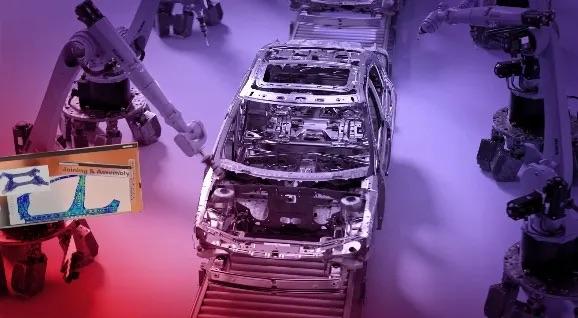
In the automotive industry, no stage illustrates the complexity of joining and assembly better than Body-in-White (BIW) manufacturing. The BIW is the structural skeleton of a vehicle—essentially everything you see before the paint shop. It consists of dozens of sheet metal panels and structural components, connected by thousands of joints ranging from spot welds and adhesives to laser welds, rivets, and mechanical fasteners. Every one of these joints contributes to critical performance attributes such as crashworthiness, stiffness, durability, and noise/vibration comfort. The sheer number of connections and the precision required make BIW assembly one of the most demanding engineering challenges in manufacturing.
Traditionally, engineers validated BIW processes late in development, once physical prototypes or tryouts revealed issues like panel distortions, misaligned gaps, or weld failures. In a virtual process chain, however, these possible issues can be addressed much earlier. Simulations help engineers optimize spot weld layouts or adhesive bonding strategies to balance manufacturability with structural strength and can predict the distortions caused by clamping and thermal effects, ensuring that panels will align correctly and that doors will close with the right feel.
By treating the BIW as a fully virtualized workflow—from CAD design to joining, assembly, and performance validation—manufacturers can move toward a first-time-right production philosophy. The outcome is faster development cycles, reduced reliance on physical prototypes, and vehicles that meet safety and quality targets without last-minute firefighting. In this way, BIW serves as both the most complex and the most rewarding example of how virtual process chains, powered by assembly simulations, deliver tangible benefits in one of the world’s most competitive industries.
Introducing Keysight Assembly Simulation Software
As powerful as virtual process chains are, joining and assembly have traditionally been a difficult link to model. That’s why Keysight developed a completely new assembly simulation solution—a tool that allows manufacturers to virtually replicate their real-world assembly processes.
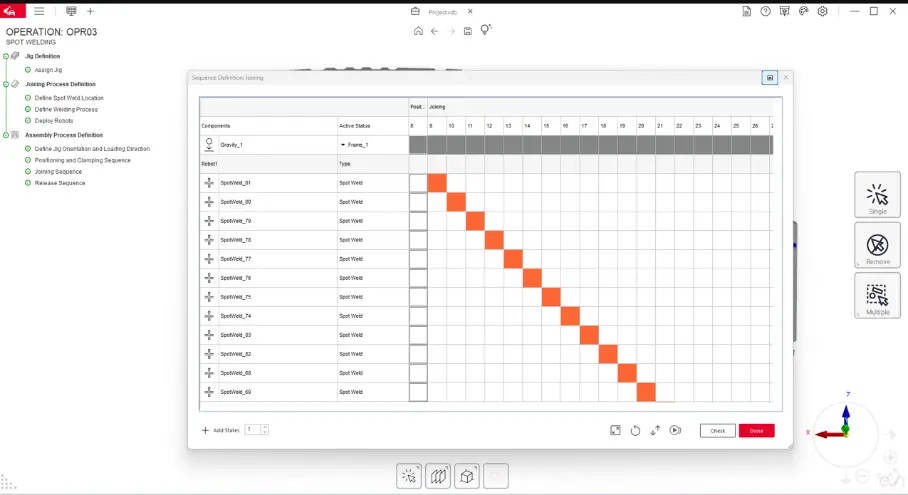
With the recently released first industrial version, automotive BiW engineers can model the entire assembly sequence: positioning parts, applying clamps, and performing spot welds one by one or in parallel if multiple weld robots are being used. When clamps are released, the software immediately shows the resulting distortions and structural behavior.
This enables teams to:
- Experiment with different process scenarios long before physical tryouts.
- Test alternative positioning strategies or clamping sequences.
- Optimize weld sequences and layouts for better quality and less rework.
The result: potential problems are spotted early, and countermeasures are validated virtually instead of through costly trial-and-error on the shop floor.
Mirroring the Shop Floor, Virtually
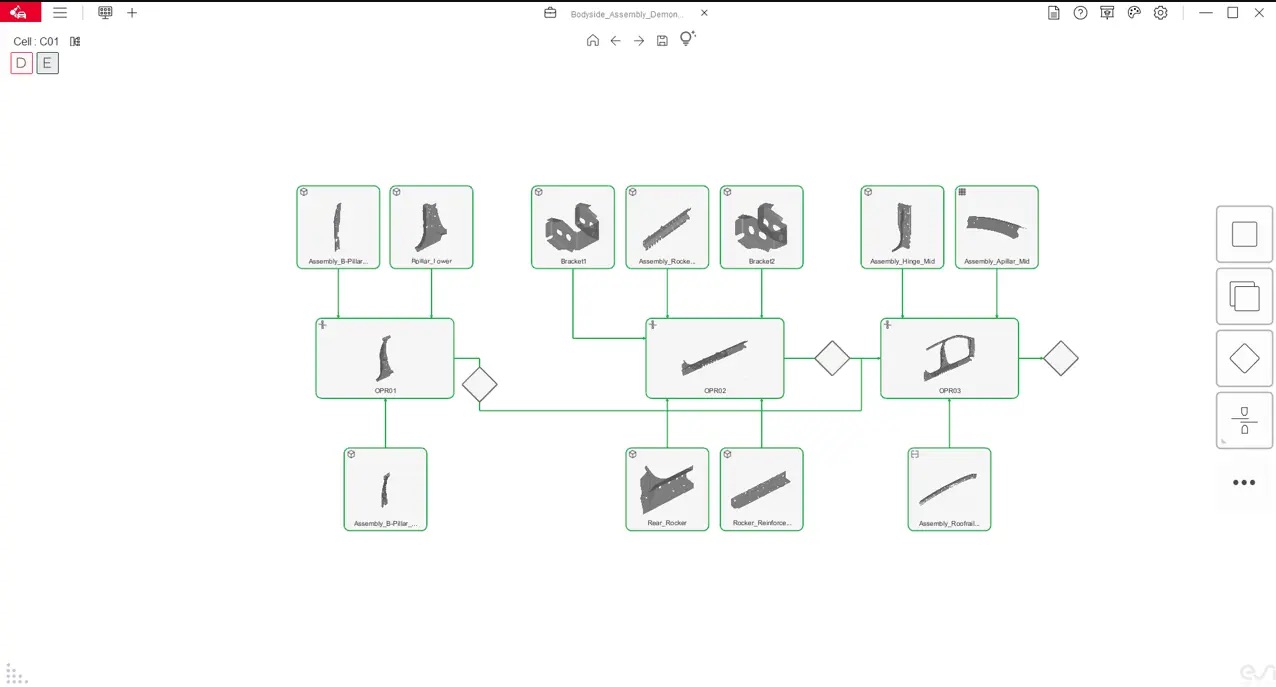
Keysight Assembly is designed to replicate the way real production lines operate, but in a fully digital environment. Instead of abstract menus or difficult configurations, engineers can simply drag and drop parts and operations into the workflow, define subassemblies, and build up the process step by step. Each subassembly can then be reused downstream—just as it would be on a shop floor—so that the virtual model reflects the exact logic of the physical assembly line. This makes it easy to visualize how complex structures come together, from individual panels and reinforcements to major body sections.
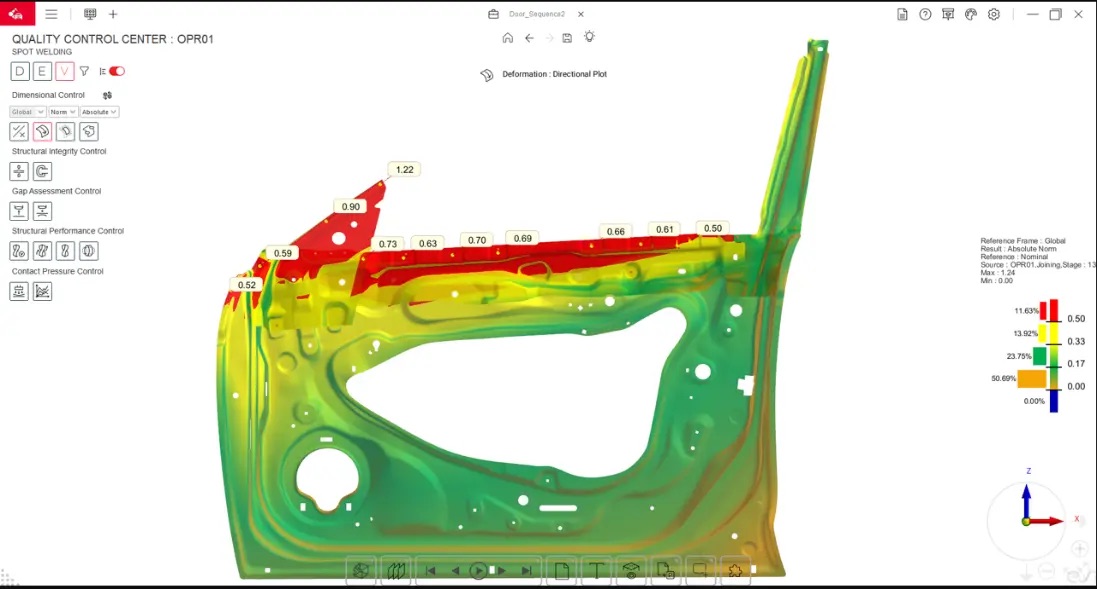
Built-in quality control gates add another layer of reliability. At every stage of the process, the simulation automatically checks for distortions, stresses, and displacements, acting as virtual inspection stations before the assembly is allowed to “move” to the next operation. Instead of waiting until late-stage tryouts to discover that tolerances are out of spec, engineers can spot issues early and correct them immediately in the virtual domain.
It’s a visual, intuitive approach that requires no complex configurations, and engineers don’t need to be finite element (FE) specialists or simulation experts to use the tool effectively. The result is a solution that bridges the gap between advanced simulation and everyday engineering practice—enabling robust, data-driven assembly processes without adding unnecessary complexity.
Handling Data Across the Development Timeline
One of the key strengths of the solution is its flexibility in handling data as a project evolves. In real product development, engineers rarely have all the information at once — part geometry, tolerances, and material behavior arrive at different stages. This tool is built to adapt seamlessly to those changes, ensuring the assembly process model remains relevant and accurate throughout the entire timeline.
- Early stage – Work with nominal CAD geometry for initial setups.
- Mid stage – Swap in simulation-based geometries for greater realism.
- Late stage – Import scanned physical part and/or entire sub-assembly data to validate tolerances against real shapes.
By supporting this continuous flow of data, the solution eliminates the stop-and-start nature of traditional validation. Instead of rebuilding models at every milestone, engineers refine a single digital model — one that grows more accurate over time and drastically reduces unwanted surprises when the first physical parts arrive.
Closing the Loop in the Virtual Process Chain
The rise of the virtual process chain is transforming how products are designed, tested, and manufactured across industries. By connecting CAD, simulation, and manufacturing planning into a single digital backbone, organizations gain the ability to predict outcomes, refine processes continuously, and reduce reliance on physical trial-and-error. Yet the true strength of this approach comes when it extends beyond product geometry and performance into the realities of joining and assembly—the steps that ultimately determine whether a digital concept can become a high-quality physical product.
The Keysight Assembly simulation platform makes this achievable, bringing practical, intuitive, and physics-based tools directly into the hands of engineers and process planners.
Looking ahead, the future of engineering lies in this digital-first, closed-loop approach—where insights from manufacturing flow back into design, and virtual models evolve continuously with real-world data. Whether in automotive, aerospace, or other manufacturing industries, organizations that embrace virtual process chains will not only bring products to market faster, but also achieve higher quality, lower costs, and greater confidence in every launch. In short, the path to smarter, more sustainable engineering runs straight through the virtual process chain—and joining and assembly are the critical links that make it whole.
Learn more about the new Keysight Assembly solution by visiting the dedicated webpage Keysight Assembly simulation software
Additional Media
Images