Improve range prediction, passenger comfort and overall energy efficiency, On-Time and Flawless Delivery
By Majid N. Aziz, Product Marketing, CAE
Lara, an experienced transporter for a cold storage packaging company primarily operating in Germany, undertakes three weekly trips between Munich and Dresden. Her role involves delivering frozen products between city warehouses, requiring strict adherence to timely deliveries while maintaining the payload at a constant temperature of -20°C.
To support sustainability goals and minimize environmental impact, the company recently transitioned from conventional trucks to electric-powered trucks. This shift aims to improve ratings on low emissions and reduce carbon footprints, reflecting a modern, eco-conscious approach.
While Lara is confident in her driving abilities and her track record of punctual deliveries, the switch to electric trucks introduces new challenges. She now faces the need to adapt to the logistics of charging and recharging the vehicles during trips. This adjustment fuels her "range anxiety," a common concern in the electric vehicle (EV) industry, which may directly influence her performance and the overall efficiency of the company she represents.
Addressing Range Anxiety: Overcoming a Key Challenge for Electric Vehicle Adoption
Range anxiety is a significant factor influencing consumer confidence in adopting EVs. While the shift from internal combustion engine (ICE) vehicles to EVs has gained substantial momentum in recent years, this transition brings with it a mix of excitement and apprehension. Automakers are increasingly committed to putting more EVs on the road, yet consumers remain concerned about the infrastructure needed to support this change.
A consumer's decision to adopt and embrace EVs often hinges on several pressing questions:
- What range can I expect after a full charge, whether driving in the city or on long routes?
- How do factors like weather conditions and driving behavior impact range?
- Can an EV provide the same comfort and deliver a unique experience compared to its ICE counterpart?
- What are the long-term maintenance costs of an EV?
These questions, compounded by the overwhelming amount of information available online about battery-powered vehicles, often complicate the decision-making process.
The anxiety surrounding EV range stems from these uncertainties. To alleviate this concern, automakers must leverage advanced engineering and cutting-edge technology to provide precise range estimates. This not only reduces drivers’ apprehension about range but also enhances their overall driving comfort and experience, paving the way for broader EV adoption.
Factors Influencing EV Range Predictions
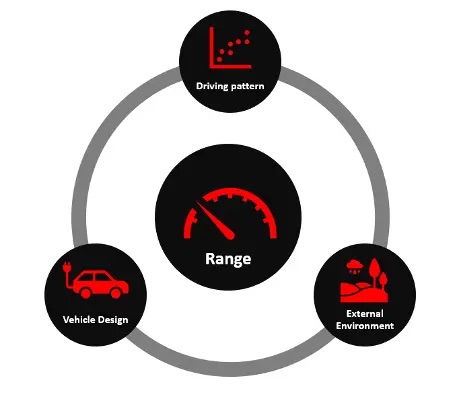
Largely the battery capacity and the overall energy consumption should help to predict the range better. However, even if you know the exact battery capacity, the energy consumption can vary depending on multiple influencing factors. Let us understand them quickly
Battery capacity and overall energy consumption are critical for predicting an EV's range. However, even with precise knowledge of the battery capacity, energy consumption can vary significantly due to several influencing factors. Let’s explore them:
- Vehicle Design: Energy efficiency is influenced by key design elements such as overall dimensions, passenger capacity, HVAC systems, battery packs, drivetrain type, tire assembly, braking and suspension systems. These defined and constant physical properties play a foundational role in range determination.
- Driving Style: Driving habits introduce variability in energy consumption. A/C usage, acceleration pedal handing, gear-shifting, and braking patterns differ among drivers, impacting energy efficiency in unique ways.
- External Environment: Weather conditions, route topology (elevation, slopes, or flat profiles), and traffic significantly influence energy consumption. For example, colder temperatures increase energy demand due to denser air creating higher (air) drag and the additional energy required for cabin heating.
All these factors exhibit nonlinear and dynamic interdependencies. A system-level analysis of these variables—and others like them—enables designers and engineers to enhance transparency and make more accurate range predictions.
The Impact of Colder Temperatures on EV Range
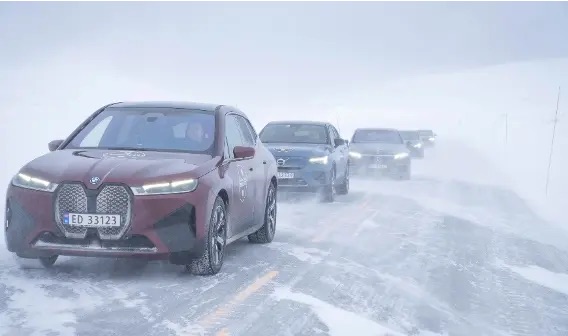
Colder climates present unique challenges for EV range performance. Cold air is denser than warm air, causing increased aerodynamic drag, and additional energy is required to heat the cabin. Heat pumps in EVs must work harder to manage heat transfer effectively, further impacting energy consumption.
Countries like the Nordics, with high EV adoption rates, offer ideal proving grounds to test EV range performance in freezing temperatures. For example, the El Prix Winter Range Test, held in January 2025 in Norway, assessed 24 brand-new EVs. Each vehicle was fully charged and driven on the same hilly route until it ran out of energy. The test compared advertised WLTP ranges with real-world distances, providing valuable insights into how weather and terrain affect performance.
Highlights from the Test Results
Here are the top 5 EVs that performed best in the test. The full results can be viewed on the Motor.no website. Source: NAF Elbil Test and Motor.no
| Model | WLTP Range Rating | Real-World Distance Covered | Differnce |
| Polestar 3 | 348 miles / 560 kms | 330 miles / 531 kms | -5% |
| BYD Tang | 329 miles / 530 kms | 299 miles / 482 kms | -9% |
| Mini Countryman | 247 miles / 399 kms | 220 miles / 355 kms | -11% |
| Lotus Emeya | 320 miles / 500 kms | 271 miles / 436 kms | -13% |
| BYD Sealion 7 | 312 miles / 502 kms | 271 miles / 436 kms | -13% |
Interestingly, the Tesla Model 3 fell short of expectations, showcasing how real-world conditions can defy expectations set by manufacturers.
The Role of Early Design Phase Testing
What if EV range and energy consumption patterns could be simulated at the system level during the design phase? This approach could potentially provide more accurate predictions of range performance under harsh or extreme conditions, helping engineers address these challenges proactively.
Would such early-stage analysis revolutionize how we design and market EVs?
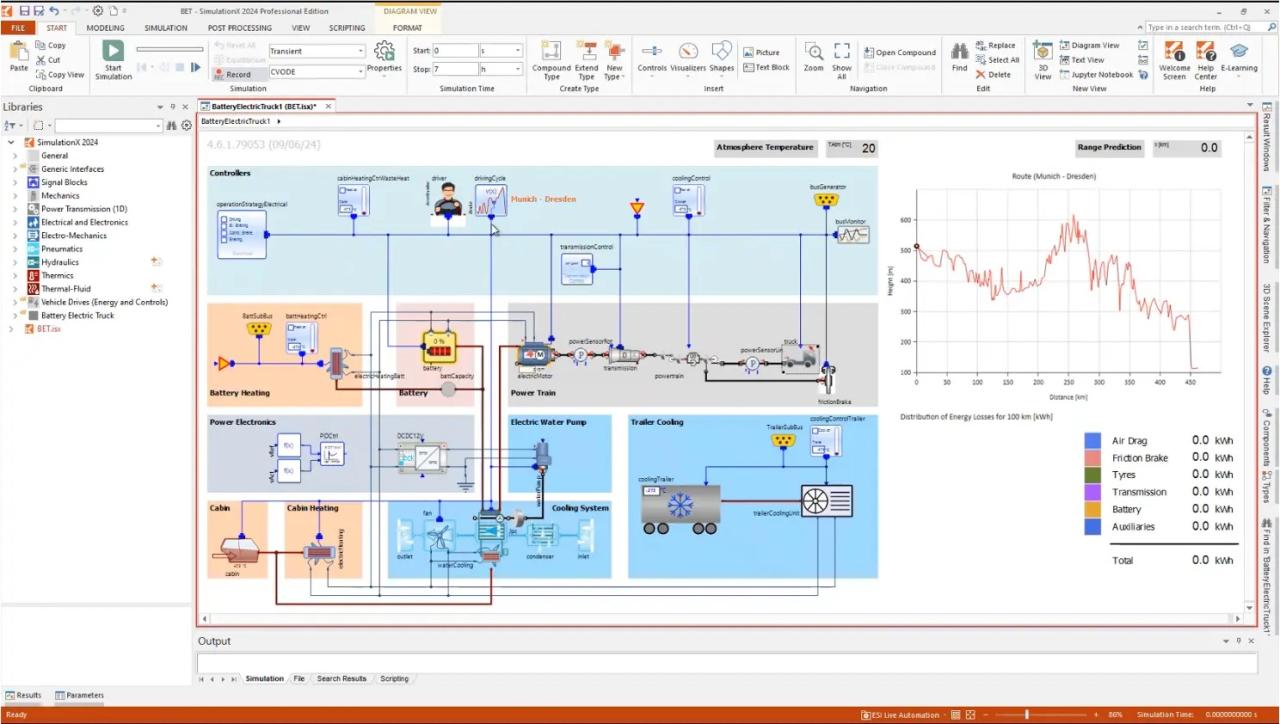
Electric Truck Model in SimulationX
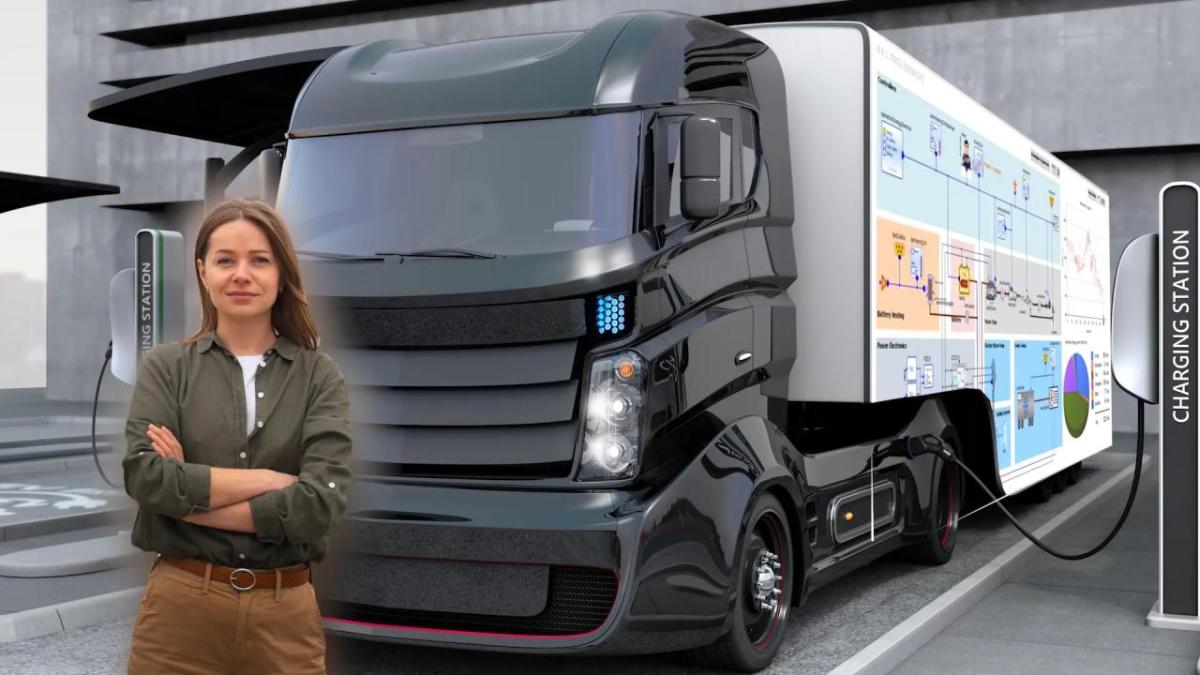
We created an electric truck model in SimulationX as shown in the picture above using the Vehicle Drive Library. This demonstrator focuses on testing the battery range for the truck vehicle running on the same route but in different weather conditions. Below are some of the key components of this model:
- Model is divided into mainly two parts: control level and physical level. They are connected here to a bus system to transfer information / data.
- The environmental temperature, air drag, and the rolling resistance can be set to a constant value, or they can be time dependent.
- Using Google maps, we have uploaded a route from Munich to Dresden in hilly terrain.
- The speed of the truck is determined based on individual curve data depending on the kind of the roads which is again taken from Google maps.
- Driver is modelled with a PDI controller to manage the drive cycles based on the velocity provided.
- Driver’s comfort in the model is only considered via the temperature of the cabin. Cabin can be heated with the waste heat of the engine cooling system and when not sufficient we can use an additional electric cabin heater.
- The powertrain of the truck itself is modelled using an electric motor, a mechanical transmission, and a frictional break.
- The battery has a capacity of 620 kWh, and we can also preset the voltage using a characteristic curve.
- At low temperatures the battery is heated to get fast a comfortable temperature in terms of performance.
- The battery and the electric motor are cooled by a cooling system based on a water-glycol cooling circuit driven by an electric water pump.
- The truck has a cooling trailer which transports frozen food at a low temperature of around - 20°C.
- All systems are controlled using an operating strategy in the model depending on the various driving conditions.
Converting Lara’s range anxiety into improved decisions & on time payload delivery
In the beginning of the article, we spoke about Lara, an experienced transporter for a cold storage packaging company and her dilemma with electric trucks. When automotive manufacturers have designed their electric trucks with full control and transparency over the actual delivered on-road electric truck, then the overall customer’s experience around range anxiety or EV adoption becomes a confident approach. We’re happy to say that Lara now loves to drive her new trailer with accurate range predictions in varying weather and hilly terrain or highways. She knows exactly how long the charge will last, when to re-charge, how long to charge and ensure the payload delivery on time. She is also quite proud that her small contribution towards adoption of greener and cleaner vehicle is making a huge environmental impact inspiring a lot of her other colleagues.
To learn more about system level simulation and SimulationX visit the webpage