New Report Examines the Evolution and Resilience of Corporate Social Responsibility in the U.S.
NEW YORK, July 14, 2026 /3BL/ - A comprehensive new report by Chief Executives for Corporate Purpose© (CECP) supported by YourCause® from Blackbaud® released today reveals that despite recurring economic disruptions, Corporate Social Responsibility (CSR) in the United States has demonstrated remarkable long-term resilience, serving as an essential stabilizing force within democratic capitalism.
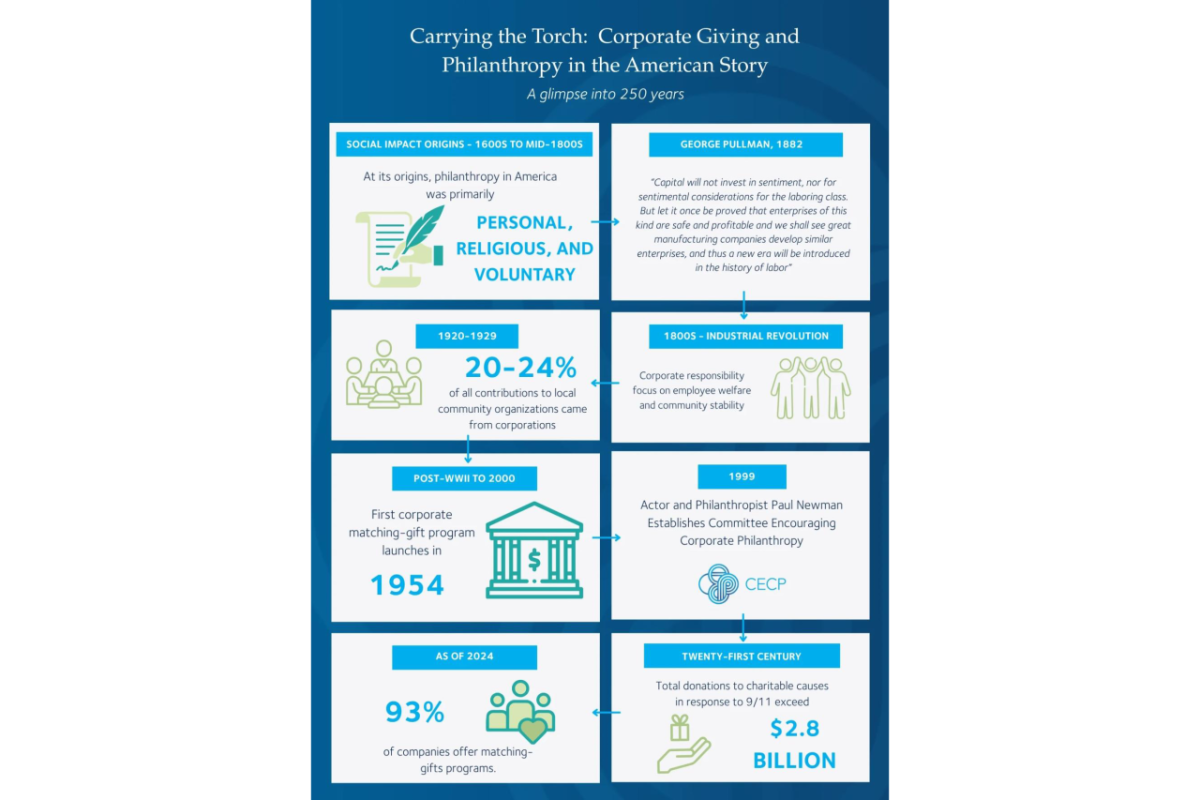
The report traces the evolution of social impact from its roots in the English Poor Law of 1601 through key historical friction points. It evaluates how corporate giving moved from legal uncertainty during World War I—the first large-scale wave of coordinated corporate donations to organizations like the Red Cross and YMCA—to formal validation under the Revenue Act of 1935. The study also analyzes how the sector matured despite intellectual resistance, such as Milton Friedman's landmark 1970 essay rejecting CSR in favor of pure shareholder returns. And it also looks at how businesses repeatedly mobilized resources to drive tangible community impact during national crises, including the $2.8 billion corporate response following the terrorist attacks on September 11, 2001.
"Looking back at the historical milestones of American philanthropy reminds us that corporate community investment is not a modern add-on, but a core element woven into the fabric of our economic system," said Leah Battin, Manager, Strategic Advisory, CECP. "As we navigate rapid technological change and shifting workforce expectations, companies have both a distinct advantage and a clear responsibility to align their community investments with a deeper corporate purpose. True innovation happens when business goals and community resilience advance together."
Data analyzed within the report from Giving USA, Blackbaud, CECP, and the IRS highlights the massive growth and institutionalization of the social impact ecosystem. Key findings show:
- Sector Growth: The U.S. nonprofit sector has expanded exponentially, growing from just over 82,000 501(c)(3) charitable organizations in 1975 to nearly 1.55 million in 2024.
- Corporate Giving Durability: According to Giving USA 2025 data, corporate contributions reached US$44.4 billion in 2024. While individual giving dropped from 80% of total contributions in 1984 to 67% in 2024, corporations have consistently accounted for 5% to 7% of total giving over the last 40 years.
- Meeting the Moment: Long-term data from CECP's 20-year matched-set of companies reveals that median Total Community Investment (TCI) grew from US$98.3 million in 2005 to $120.2 M in 2024. Intermittent spikes—such as a jump to US$174.7 million in 2020—demonstrate that corporate giving regularly rises to meet changing moments of economic, political, and social dynamics.
- The Matching Gift Standard: Highlighting the deep integration of workplace giving, the report notes that since the GE Foundation launched the first 1:1 corporate matching-gift program in 1954, the benefit has become a standard practice, offered by 93% of companies by 2024. According to CECP’s Giving in Numbers® data, the median total community investment per company sits at US$21.5 million.
“Overtime, the right technology turns manual, localized giving into scalable, data-driven global impact," said Dale Strange, president, Corporate Impact, Blackbaud. "By utilizing automated matching-gift platforms and digital grants management, companies are streamlining their operations and removing barriers to employee engagement. This technological shift not only clarifies success metrics for corporate leaders but also provides nonprofit partners with the efficient, transparent support necessary to address modern societal needs."
Looking ahead, the report notes that contemporary CSR is increasingly shaped by technology and employee choice. Case studies featured in the report illustrate how modern enterprises leverage digital grants management and workplace giving platforms to streamline global impact, automate matching gifts, and capture clearer data metrics.
As workforce trends shift, future strategies must balance digital enablement with an authentic employee voice. With 71% of Americans believing it is vital for the country to provide opportunities for prosperous lives, but only 19% believing it does so effectively, the report concludes that integrated corporate purpose will remain paramount to building healthy, resilient communities over the next decade.
The full report, featuring historical milestones, data trends, and future-looking insights from CSR leaders, is available for download here.
###
About Chief Executives for Corporate Purpose (CECP)
Chief Executives for Corporate Purpose® (CECP) is the only nonpartisan business counsel and network dedicated to driving measurable returns on purpose. We promote responsible purpose-driven business as it increases customer loyalty, builds employee engagement, improves brand trust, attracts top talent, connects with strategic investors, and contributes to the bottom line.
More than 200 of the world’s leading companies seek to improve their return on purpose through access to CECP's solutions in insights and benchmarking. With our companies, we harness the power of purpose for business, stakeholders, and society.
For more information, visit http://cecp.co.