By Fast Company Expert Blogger Alice Korngold
Imagine a company catalyzing a new approach to student learning and achievement in science, technology, engineering, and math (STEM). And what if the company’s purpose were to prepare students around the world, from all corners and walks of life, to collaborate in solving social and environmental problems, beginning right now?
Imagine the power of the relationships these children will have when they are in their 20s and 30s as they continue to work with each other.
Sound ridiculous to you? Do you wonder: How is this possible, given that one billion children live in poverty, many in remote rural villages, others in densely populated urban slums? When so many children in developed countries aren’t even getting decent educations, much less children in the developing world?
What if I told you that middle school and high school students from some of the world's most deprived communities are already working together on solutions for sustainable energy sources and to purify water? That 250,000 students are already collaborating on STEM projects through 60 schools, universities, and NGOs around the world? And that plans are well under way to scale such educational opportunities to reach millions?
What I just described is pilot program for Hewlett Packard’s Catalyst Initiative. Catalyst is part of HP’s Social Innovation program, which encompasses education, entrepreneurship, health, and community. Particularly distinctive about Catalyst is that “all the learning creates far-reaching results in problems facing humanity,” says Ajith Basu, chief program executive for the Agastya International Foundation, and head of the New Learner consortium of Catalyst.
While HP’s Social Innovation program can be considered a particularly evolved case of corporate social responsibility, I think it is much bigger. Corporate Global Vision (CGV), a concept that I have articulated, is a better descriptor: Envisioning and achieving the greater potential for both the company and the world by affirming the interdependence of corporate success with the health and prosperity of the planet and its people.
“We wanted to figure out how to create immersion learning experiences," said Gabi Zedlmayer, vice president of HP’s Office of Global Social Innovation, when we got together at the Clinton Global Initiative Annual Meeting last fall. “We know that technology alone is not the solution. So we decided to build a network of schools and people across boundaries and frontiers to find a different way of learning.”
HP's goal with Catalyst is to reimagine STEM education and the classroom, Jim Vanides, senior program manager for HP, said in an interview. He described how HP established “an international network of innovation sandboxes” to answer the question: “What does a powerful learning experience look like, and how does technology enable it?” Further, he explained, HP's goal is “STEM plus”--not simply STEM, but also creativity, collaboration, and problem solving--“all that students will need to be valuable citizens of the world.”
According to Vanides, by raising STEM+ literacy and increasing the quality of the STEM pipeline, the next generation will be prepared to solve the large and seemingly intractable social global challenges.
"Breaking down all barriers is fundamental to success," said Vanides. "Barriers between countries, secondary and college education, universities and NGOs. At work, we solve problems through collaboration with people throughout the world. If young people learn to engage in learning and problem-solving without any silos, they will be prepared to have an enormous impact.”
HP had a vision of the true potential of children of all backgrounds throughout the world.
“This experience has transformed me," said Basu. "My greatest learning has been that children have no problems anywhere. The problem is the system and the lack of resources.” Even in the poorest, most remote neighborhoods of India, Basu says, "the children are much smarter than we were. Much faster. We must create systems around that. We can create powerful learning communities.”
Re-imagining education is not a fantasy. It’s becoming a reality.
Consider a student in a classroom of 35 students that never had funds for lab equipment. Starting last year, via Catalyst, she can conduct experiments remotely by using laboratories at MIT and the University of Queensland in Australia. She can, for example, measure radiation emissions as a function of how far she holds her cell phone from her ear. She can design the experiments herself, and watch the Geiger counter in Australia via live media. She can run the experiments as many times as she likes at her own pace, produce a lab report, and then compare results and experiences in the classroom with her teacher and fellow students. The results are already in: Students who use the virtual instruments show significant increases in test scores.
I actually ran the experiment myself online while Skyping with Dr.
Kemi Jona, Ph.D., director of the Office of STEM Education Projects at Northwestern University. Science was never so fun, and it stimulated my curiosity. “Here’s the vision: Remote labs can be transformative at a district, state, or national level because you can create a server function or cloud solution that can provide a centralized shared facility of science experiments," says Jona. "A district no longer needs to buy lab equipment for each school as we do now in the current funding model…a model that is financially prohibitive for most communities.”
Next, imagine students in the remotest villages in India helping to find solutions to waste management by participating in science projects via mobile science labs, science fairs, and young instructor leader programs. This is already happening through the Agastya International Foundation.
Through 62 mobile science vans that take science education to the village doorstep, 28 rural science centers, and a 170-acre Creativity Lab campus, Agastya has reached over 4 million children and 150,000 teachers in several Indian states and is supported by scientists and educators from the Indian Institute of Science, Defense Research and Development Organization, and the Tata Institute of Fundamental Research.
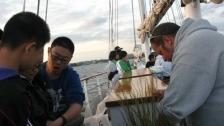
And finally: Imagine a magnet middle school in Stamford, Conn., where 50% of the students are from educationally disadvantaged families, helping to solve local well water contamination problems through a partnership with middle school students in Shandong University Middle School in China. Throughout the process, the students from Stamford are learning Mandarin and the students from China are learning English. (Students are pictured, top, collecting water samples from Long Island Sound.)
“This began with our seeing water contamination in our local water wells as a teachable moment," said Bryan Olkowski, assistant principal at
Scofield Magnet Middle School. "Then, by engaging in Catalyst, the world has opened up to us." Since 2010, Scofield students have worked in partnership with students at their sister school in China, remotely and through exchange visits. They are collaborating using geospatial information studies (GIS), technology, and systems with university faculty and resources provided by HP.
Scofield teachers traveled to New Dehli last spring to present at the international
Catalyst Summit, attended by all of the consortium partners; a new group of Scofield teachers will participate in the follow-up Summit this spring in Beijing. And HP has introduced new funders to Scofield, including the
International Society for Technlogy in Education.
According to Olkowski, one thousand students in Connecticut have already benefited from Catalyst, as well as 640 in China. He believes that the project is a contributing factor to increasing math and reading scores on state tests for kids in his school.
“This is what’s possible for public school education,” said Olkowski. And that key message from this project is spreading: U.S. Congressman
Jim Himes visited Scofield, and Olkowski was asked to brief the U.S. Congress on the project.
Scaling the solution through further investment, collaboration, and advocacy.
Beyond the sharing among the Catalyst consortium partners, further collaboration occurs between HP and corporate, foundation, and government leaders.
Jeannette Weisschuh, HP's director of education initiatives, spoke with me last week from London, where she attended the
Education World Forum, the largest global gathering of education ministers. “The focus here is on innovative concepts to jointly increase student performance, especially in STEM education and entrepreneurship [and] using technology to increase student outcomes and enhance learning experiences and achievement in all disciplines, for the purpose of building a better world.”
With the pilot phase just completed, HP is embarking on Phase II. This year, HP will determine which of its innovation sandboxes is yielding the best results, invest further resources accordingly, and engage additional funding partners in order to scale the best solutions.
A particularly important HP partner has been the
World Economic Forum’s Global Education Initiative. Additionally,
OECD is working with HP to study the best uses of technology to advance STEM education through innovative learning environments; together they will issue a report at the end of this year.
Corporate Global Vision: Envisioning and achieving the greater potential.
The field of corporate social responsibility (CSR) has been maturing for over two decades. Since the 1990s, many of us have been helping companies transition from philanthropy and service to CSR--an integrated strategy that advances social and environmental purposes while also enhancing corporate financial value.
Corporate Global Vision (CGV) takes the C-suite and boardroom view. With Catalyst, HP demonstrates the problem-solving capabilities of HP technology; expands markets by increasing education rates and wealth worldwide; and builds relationships and goodwill with customers, including businesses, governments, NGOs, and individuals.
David Packard understood this when he said that “the real reason HP exists is to make a contribution, to improve the welfare of humanity.”
HP20282