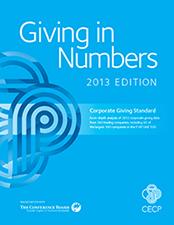
September 16, 2013 /3BL Media/ - Despite the continued impact of the global recession on businesses, 59 percent of companies, many without waiting for their own profits to recover, recommitted to their communities by giving more to charity in 2012 than they did in 2007, before the recession took hold. This finding headlines Giving in Numbers: 2013 Edition, released today by CECP in association with The Conference Board. The report, available at no cost, is the leading annual analysis of corporate giving patterns. These commitments by companies also became more focused on specific program areas, leading with K-12 and higher education, and innovative, relying more on non-cash contributions such as products and skills, all signaling their desire for greater and longer-term societal impact through their investments.
”The world’s largest companies saw that societal investments were a way to help with recovery, not only for their communities, but also for the companies themselves,” said Daryl Brewster, CEO, CECP. “Fortune 500 companies know how intertwined they are with the communities around them; healthy companies need healthy communities. Even when times were tough for these companies, they understood that it was part of the path to recovery to continue to stand alongside their community partners.”
This year’s Giving in Numbers represents trends drawing on data from a record 240 companies—including 60 of the top 100 companies in the Fortune 500—and reported more than $20 billion in total contributions in 2012.
“Companies are looking deeper into their core strategies and across business units to determine the most strategic ways to invest in addressing societal challenges,” said Jonathan Spector, President and CEO, The Conference Board. “The benefit behind companies being a better community partner is that these societal solutions also solve core business challenges, simultaneously. From engaged employees to more efficient use of surplus products, benefits are streaming both ways.”
Key findings include:
Corporate Societal Giving Showed Considerable Growth (pages 9-11)
- Total giving increased for 59% of companies from 2007 to 2012, with 38 percent of all companies increasing their giving by 25 percent or more.
- Aggregate corporate giving rose by 42% ($4.48 billion) from 2007 to 2012 in inflation-adjusted dollars.
Non-Cash Giving Defined Post Recession Contributions (pages 12-13)
- Of companies that provided non-cash support in 2007, the median percentage change in non-cash contributions was +38% in 2012.
- Non-cash support includes product donations and other in-kind resources, such as excess inventory, pro bono service, use of company facilities, intellectual property, land, and other asset donations.
Education Takes the Top Spot (pages 18-20)
- For the first time since Giving in Numbers was first released in 2006, giving to higher education and K–12 education combined to become the top program area for all companies, representing 29% of the typical company’s programmatic allocation.
Companies Engaged Employees in New Ways (pages 27-32)
- Since 2007, the percentage of companies offering Paid-Release-Time volunteer programs increased from 53% to 70% in 2012.
- Matching-gift programs evolved and disaster relief matching-gift programs became more popular from 2007 to 2012.
Modest Increases Expected in 2013 Giving Levels (page 15)
- Forty percent of companies expect giving to increase from 2012 to 2013, while 18% expect a giving reduction. Forty two percent of companies expect no change in giving levels from 2012 to 2013.
Special In-Depth Analysis of Pharmaceuticals and Financials Industries (pages 43-44)
Giving in Numbers is a relied-upon measurement tool for corporate senior executives to assess and build their companies’ giving programs. The report’s Benchmarking section includes a Year-Over-Year Giving template with a step-by-step guide and definitions of terms used in the field. Giving officers report that this is a must-read as one starts or enhances a corporate giving program.
“The [Corporate Giving Standard] has helped us build the case for maintaining funding in a difficult budget environment,” stated one financial services and communications firm in response to this past year’s survey.
The annual
Giving in Numbers report is based on data drawn from the
Corporate Giving Standard (CGS), a peer benchmarking tool for corporate giving professionals. Through an annual survey, CECP, in association with The Conference Board, collects and reports data on numerous aspects of corporate giving trends. Launched in 2001, the CGS now accounts for more than $130 billion in corporate giving data. Watch a
video presentation of the highlights of the 2012 CGS data from earlier this year at the CECP Summit. For more information on participating in the annual CGS survey, contact CECP at
[email protected] or 212-825-1000.
###
About CECP
CECP draws together and empowers senior executives of the world’s leading companies to achieve unprecedented progress on societal challenges while driving business performance. CECP offers high-powered connectivity and the platform to multiply investments in solving societal challenges. CECP uniquely enhances its members’ societal initiatives through strategy-related expertise, influential advocates, and awareness building, and by offering members essential resources including a proprietary benchmarking tool, networking programs, research, and opportunities for best-practice sharing.
http://cecp.co
About Giving in Numbers
Developed by CECP in association with The Conference Board, Giving in Numbers: 2013 Edition is based on data from 240 companies, including 60 of the top 100 companies in the Fortune 500. The sum of contributions across all respondents of the 2012 Corporate Giving Survey (CGS), from which the data is pulled, totaled more than $20 billion in cash and product giving. This report not only presents a profile of corporate giving patterns in 2012, but also pinpoints how corporate giving has increased from pre-global recession in 2007 through 2012. This is the ninth annual report on trends in corporate societal engagement.
About The Conference Board
The Conference Board is a global, independent business membership and research association working in the public interest. Our mission is unique: To provide the world’s leading organizations with the practical knowledge they need to improve their performance and better serve society. The Conference Board is a non-advocacy, not-for-profit entity holding 501(c)(3) tax-exempt status in the United States.
www.conference-board.org