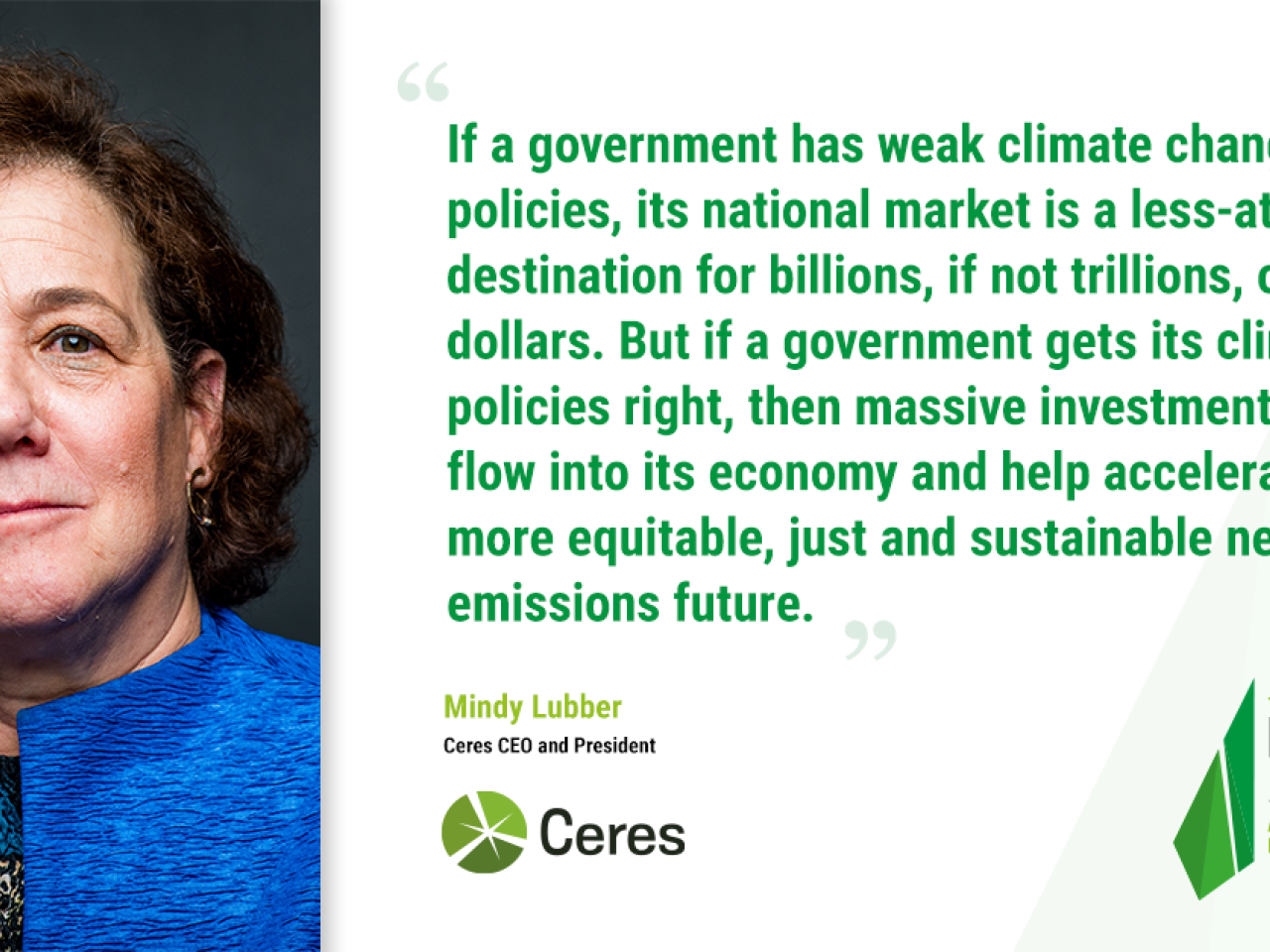
457 investors managing more than US$41 trillion in assets have released a new joint statement to all world governments urging a global race-to-the-top on climate policy
Historically, most utility capital investments focused on regulated generation and transmission assets that provided the basis for customer rates structures and returns. But the growing interconnectivity within utility assets and electric distribution networks now requires a more holistic approach to planning, and many regulators are requiring utilities to invest in distribution under similar reliability mandates to those governing generation and transmission markets.
KeyBank has provided a $6.5 million bridge loan to Harmony Housing, a 501(c)(3) nonprofit organization dedicated to providing safe, clean and comfortable affordable rental housing throughout the United States. Key has provided financing solutions to Harmony Housing since 2014, financing 25 of its last 28 transactions.
Answering the call for increasing energy self-reliance, a grassroots electricity-sharing model is emerging. “Community microgrids,” comprising community-owned or subscribed solar PV and other renewable energy sources, offer participants and surrounding consumers the security of energy resilience in times of grid failure and protection from energy price increases driven by volatile energy markets.
GRI and the UN Conference on Trade and Development (UNCTAD) have signed an Exchange of Letters to deepen the organizations’ collaboration on responsible investment, including work related to the Sustainable Stock Exchanges initiative. The collaboration will allow the organizations to reach key players in the investment chain to raise awareness on how sustainability reporting can pave the way to a green economy.
It is well documented that CSR practices are both an emerging and rapidly expanding set of standards for 21st century corporations. As $30 to $40 trillion shifts hands from the current generation to the upcoming millennials over the next few decades, there are markedly different standards that companies must uphold to gain traction in the evolving investor and consumer market.
The Global Impact Investing Network (GIIN) announced the appointment of Mark Grier as its new Board Chair. Grier serves as Vice Chairman at Prudential Financial Inc. Grier’s appointment marks a milestone in the advancement of the GIIN, which will benefit from Prudential’s more than 40 years of institutional impact investing experience.
Black & Veatch is partnering with the Buffalo Niagara Medical Campus to design and assess the financial and energy efficiency impacts of a microgrid in Buffalo, N.Y. The microgrid will provide resilient, clean energy for the 120-acre campus, long-term cost-savings and potential monetization opportunities for member institutions.
In 2016, we expanded our existing approach to filing and enforcing patents to ensure we balance the need to protect our intellectual property with a country’s economic maturity.
Black & Veatch’s 2017 Strategic Directions: Smart City/Smart Utility Report reinforces lessons learned in the past year—although governments and municipalities believe strongly in the smart city model, they continue to struggle to fund these efforts. According to survey data, only 16 percent of municipalities can self-fund a smart city initiative, a little over a third cannot.
As the newly appointed Chair of the GRI Global Sustainability Standards Board, Judy Kuszewski wants to see a stronger link between sustainability and business strategy, and deeper collaboration between reporting frameworks. Find out more about Kuszewski’s vision about the future of corporate reporting.
Trane Technologies is a global climate innovator with a clear purpose to boldly challenge what’s possible for a sustainable world. See how embedding...
AEG embraces its responsibility to enrich the lives of people in the communities around the world where we do business, and to use business to create...
In states where Key has a presence, there are approximately 1.7 million low- to moderate-income (LMI) households. Many LMI individuals don’t have bank...
In states where Key has a presence, there are approximately 1.7 million low- to moderate-income (LMI) households. Many LMI individuals don’t have bank...