This post is a transcript of Tandem Global CEO Margaret O’Gorman’s 2026 State of Corporate Conservation speech, presented in Austin at the Tandem Global Conference 2026 on June 2, 2026.
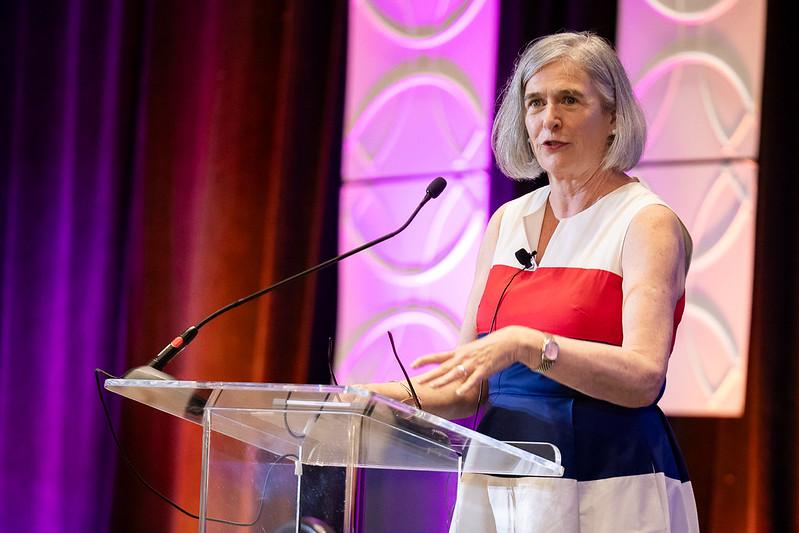
Hello everyone. I’m always thrilled and honored to stand on our conference stage and talk to this truly inspiring collaboration of Tandem Global members and partners coming together to deliver quality content and conversations that celebrate and support your work.
Collaboration is something I’ve been thinking about a lot this year as I’ve travelled, visiting programs, and members, and stakeholders. I’ve been thinking about the importance of collaboration but also of community and continuity and how critical they all are to the work we do and celebrate today.
When I think of collaboration, there are so many examples that come to mind that show how collaborative efforts have delivered excellent results for business and nature and how the best outcomes happen when groups with a little or a lot in common work together towards a shared goal.
Across Tandem Global and our conservation, corporate and social impact efforts we see collaboration for nature happen repeatedly and each collaboration delivers learnings to build better efforts, and we can also learn from the successes of historic collaborations that have used collective energy to pursue sometimes seemingly unattainable goals.
A timely example, given the 250th anniversary of the founding of the United States, is the successful collaboration for the enduring symbol of the U.S., the American Bald eagle.
The American bald eagle was included in the Great Seal of the U.S. in 1782, by fellow Irish-person, Founding Father and first secretary of Congress, Charles Thomson, who is credited as a co-designer of the seal with William Barton.
The bald eagle is one of the largest raptors in North America, having a wingspan of 6 to 7 feet which allows it to soar to heights of 10,000 feet with little effort. They build nests that last decades, with a record-breaking nest in Florida measured at 10 feet in diameter, 20 feet in thickness and in use for 30 years. Before its inclusion on the Great Seal, the bald eagle was already an iconic bird for the tribes who saw the eagle as a messenger between humans and spirits.
Back when the nation was being formed and when land was being managed sustainably, the bald eagle was common across the continent. Records of numbers were not kept at the time, but some estimates suggest that when the eagle was chosen for the Great Seal in 1782, there were 100,000 nesting eagles across what is now the lower 48 states of the US.
From its adoption as a symbol of the US to today, the bald eagle as a species has experienced highs and lows as its habitat and numbers have seen decline and restoration over the last 250 years. In fact, the US nearly lost its iconic bird twice.
The first time, the loss of the birds was from a methodical massacre. Across the 1800’s bald eagles were shot due to the mistaken notion that they stole children and were a threat to livestock. The federal government’s department of agriculture established official bounties of 50 cents – about $100 in today’s value - for every eagle killed.
The killing of birds was not just eagles – crows, blackbirds, and owls all had bounties. These policies had an impact on all bird populations, some of which have never recovered, like the passenger pigeon. Its very existence was wiped out in the US during this time-period when the population of billions of passenger pigeons collapsed to extinction which was recorded on September 1st, 1914, when the last passenger pigeon named Martha was found dead on the floor of her cage in the Cincinnati Zoo.
These bird bounty policies were under pressure at the beginning of the 20th century and the extinction of the passenger pigeon added to the increasing disdain for the practice of birds killed for bounty. In 1940, in response to declines in bald eagle and golden eagle numbers, Congress passed the Bald Eagle Protection Act which made it illegal to kill or capture these birds.
But this was not the end of the pressure on these birds, it was after the bounty killing stopped that the bald eagle suffered most. Following industrialization and the massive growth in industries following World War Two, the eagle was dealt an almost fatal blow when DDT was introduced as an insecticide used in agriculture as well as homes and gardens. DDT is considered the first modern synthetic insecticide, and it was approved by the government for widespread use. Little then was known about the environmental damage and risk to human health it would cause.
Throughout the 1940s and 1950s, DDT made its way into the waterways, into the food chain and eventually into the bloodstream of species like the bald eagle. In the 1960’s and 70’s efforts had begun to limit the use of DDT driven in part by declining benefits but also by concerns from the burgeoning environmental movement informed by author Rachel Carson who, in writing Silent Spring, described an environmental disaster that nobody saw and nobody heard.
Rachel Carson observed the silence of the skies as the dawn chorus – the morning cacophony of bird song – dimmed and as mating calls, warning calls, and nighttime calls faded into silence. She documented a link between the widespread and broadcast application of DDT to the decline in bird species.
This book was acclaimed as the catalyst of the modern environmental movement. This modern movement succeeded early environmentalism that focused only on protecting wild places through the creation of National Park System. This modern movement cared about these wild places, but it also cared deeply about everyday places, everyday people and once common species.
At this time of environmental awakening, the Clean Air Act, the Clean Water Act, the EPA and the Endangered Species act all came into force, all advanced during the Nixon administration.
At that time, the prevalence of DDT in the water and the food-chain had caused the population of bald eagles, the most iconic bird in America, to collapse to 417 nesting pairs.
How did DDT do such damage to the bald eagle population? Bald eagles themselves were not being sprayed with DDT so how come there was such a concentration in their bloodstreams? This is due to two processes – bioaccumulation which is the build up of a toxin in an individual organism and biomagnification which is the compounding build up as the toxin moves up the food chain. Because eagles need to consume massive quantities of prey to survive, they ingest more toxins that species lower on the food chain and so suffer more when damaging toxins are released. Research found that levels of DDT in the blood of bald eagles were causing eagles to lay thin shelled eggs that could not withstand an incubation period which caused the population to crash.
DDT was banned in 1972 following scientific evidence that the chemical caused severe environmental and wildlife damage. The Endangered Species Act was signed into law by President Richard Nixon in 1973.
In 1976, the bald eagle was listed as endangered in the lower 48. And with a remaining population as low as 400 breeding pairs, fewer than 1,000 birds, its extinction was almost certain.
But today there are more than 300,000 bald eagles across North America.
300,000 eagles in every state except Hawaii. An estimated 500 eagle nests in New Jersey, one of the most urban states in the country while states like Michigan with less urbanization and large areas of fresh water are home to thousands.
So, what was the path from 800 birds to 300,000?
It was a path of collaboration, community, and continuity.
When scientists realized that the remaining birds were laying eggs that would never successfully hatch and fledge, that would never produce young, they knew extinction was around the corner. A species can’t recover if it can’t reproduce.
Scientists in state and federal wildlife departments proposed a novel approach that would use eaglets from successful nests to rebuild the population. This collaboration brought together wildlife scientists and researchers as well as healthy eaglets from Maine, Canada and Alaska where populations were less impacted by DDT.
These eaglets from Maine, Canada and Alaska were transported to places considered safe and suitable for nesting and introduced into the population in two ways, hacking and fostering.
Hacking is a process of hand rearing eaglets towards independence without making them attuned to humans while fostering takes advantage of existing but unsuccessful pairs.
First engineers had to design hacking towers – platforms constructed at the same height and in similar locations to bald eagle nests. These towers allowed the chicks to fledge into the wild while also keeping them safe. It allowed the chicks to be fed without seeing or becoming used to human presence. Hacking was very experimental and untried. Biologists did not know if the eaglets would learn how to hunt without parental training. But the birds did learn to hunt and feed on their own. Hacking was a success.
And for fostering, which was also experimental, scientists removed thin shelled eggs from impacted nest and replaced them with dummy eggs. During the period of normal incubation, the eagles cared for the dummy egg, but four weeks in, scientists would bring a new chick from a captive breeding facility and transplant them into their new home.
Fostering was successful like in New York state where the last remaining pair of bald eagles accepted, cared for and successfully fledged fostered eaglets for 3 years and when the male of this pair died, the female mated with a hacked bird and the pair fostered five more chicks in subsequent years.
Along with biologists, researchers and engineers, landowners also became part of the collaboration since many nests were established on private lands and the recovery effort depended on every single nest being successful regardless of whether it was in parkland, a wildlife refuge or private land. The future of the bald eagle depended on a public private partnership.
Another aspect of this incredible effort was community in the form of volunteers or citizen scientists. With only one and two pairs of eagles remaining, it was important that every nest be monitored which was impossible for under resourced wildlife departments so biologists turned to the public and recruited an army of bald eagle volunteers who monitored every single nest across the breeding and fledging season, a task that spanned months and provided important intelligence to address issues like chicks falling from nests or nests failing from weather.
Through collaboration, community and continuous effort over 30 years – an entire career for many people – this American icon was brought back from the brink of extinction to be de-listed in 2007 and continues to recover and grow in numbers today.
As bald eagle populations are thriving, Tandem Global members contribute to the continued stewardship of this iconic bird across 18 of our WHC-Certified programs. A well-known eagle spotting site and certified program is at DTE’s cooling station at their Monroe Power Plant on the shores of Lake Erie while members like CRH, Freeport-McMoRan, Vulcan, WM and others all monitor nests on their properties.
And it’s not just bald eagles that have benefited from collaborations, so have many other species and ecosystems. Through collaboration, incredible recovery stories for bald eagles, ospreys, bison and wolves have been realized. Through community, coalitions focused on singular outcomes like species recovery have been built and through continuity, intractable problems have been solved.
I see this conference as a community of collaborators solving problems and continuously delivering and driving towards a world with better outcomes for people, nature and the future.
At Tandem Global, we collaborate to achieve everything we do. During our recent Executive Roundtable on AI, Dr. Neelam, a researcher at NASA, said “no one entity has broken it, so no one entity can fix it.” She was talking about water systems in the US and about basin-wide restoration approaches being led by groups like Ecolab for companies and communities to collectively address water stress. But she could have been talking about the recovery of the bald eagle or any of the other intractable problems we face today because… no single entity did or can do it all…not the federal government, not advocacy groups, not scientists and not private philanthropy…as we say here at Tandem Global together always leads to better.
And when we talk about better, the things we point to as impacts for better are the results from our certification applicants. Our WHC Certified numbers are our KPIs for nature – and when consolidated clearly illustrate collaborative impact across space and time.
This certification collaboration has been ongoing for 45 years and has delivered some great results for nature.
This year’s cohort of program applications have been no different delivering results for nature across habitats, species, employees and community. 2025 saw the submission of 284 program applications. With 5 successful NEW program applications this year from Lundin Gold, Boehringer Ingelheim, Suntory Global Spirits and Peckham Industries, this means 279 applications were renewed, maintaining their certification and through continuity adding more value. Of all total applications over 1,000 projects were submitted. As usual the most popular project types this year were Avian Projects followed by Awareness and Community Engagement Projects then Landscape Projects with Grasslands, Pollinators and formal learning all well represented in this year’s cohort.
The 2025 cohort of applications spans 10 countries. It is great to see the spread across north and south America and in Europe.
I want to thank every applicant this year. We know the application process is not the easiest, so we appreciate all the hours you dedicate to maintaining and growing your programs but also to monitoring and submitting your application.
And it wasn’t only applicants that were returning good numbers this past year. Our consulting team supported a total of 213 separate sites in the last year helping members and non-members in all aspects of supporting planning, developing, maintaining or growing a corporate biodiversity program. The team supported 39 different companies with a diverse suite of programs that included Biodiversity Net Impact Assessments, scorecard development, capacity building and integrated social impact support and a variety of customized support services that meet companies where they are on their nature journeys.
The diversity of these engagements allows us to have a finger on the pulse of how the corporate sector is engaging with nature at their locations and also in the corporate offices. We can identify trends that we are seeing in this arena.
We’re identified trends that impact from the enterprise level to the site of operation.
Firstly, we are seeing more companies engaging in net impact assessments at their sites. We have developed a methodology working with CRH to assess Net Impact at 20 quarry sites this year. We look at the baseline and the current state and compare it to the reclamation plan to identify where additional efforts are needed to leave the location with a net positive impact on nature. In some cases, we are seeing that reclamation can move a location from having habitat with low biodiversity values to one with higher biodiversity values than existed in the pre-development state.
We are also seeing increased interest in nature metrics among our members and clients, as more organizations ask us to help identify which indicators are right for their efforts. Our knowledge of our members’ operations and business helps cut through the noise and understand what works for their particular situation. That’s important - with all the different methodologies out there, it’s great to be able to simplify approaches so that the right metrics are collected to assess the right impacts. I am heartened to see this trend as it means that many companies are moving from assessment to action which is critical to create a nature positive future.
When we look at our site support, this year the technical team reviewed 88 project applications prior to submission to help teams deliver their strongest application. They delivered support calls, gap analyses and playbooks to strengthen members’ site-based approaches. They delivered training to build capacity for sites seeking to acquire or retain certification.
Across our members, we are also seeing innovation and action for nature, climate resilience and community impact. With Toyota we continue the work to identify Indicator Species at their facilities. With WM, we continue supporting their micro-forest tree plantings in 3 locations this year. With GM we developed internal scorecards for pollinators and to raise awareness of threatened and endangered species in the regions they operate. Our social impact work with bp, Phillips66, DTE, Marathon and others, continues in Michigan, Illinois, Indiana, New Jersey, Louisiana and Texas where members are realizing tangible benefits from investing in nature-based solutions with community engagement and support. All told, we innovated and implemented with 39 different companies this past year.
It’s so great that our members never stop innovating for nature as it keeps us busy and creative and happy to help. Much of the innovation at the moment is centered on the many new and interesting uses of tech, so much so that we are standing up a Tandem Global Tech Peer Group with members sharing how they are using tech for wildlife, water, soil health etc. This peer group will become a clearing house of sorts as we work to sift the aspirational nature tech from the use-ready nature teach and highlight practical and realistic use cases.
And innovation does not stop with tech. Innovation is internal to Tandem Global too.
As we grow into our new name and new mission, we are engaging with companies and other stakeholders in new and different ways, all towards moving business and nature together in tandem and in collaboration.
And while collaboration is an important part of a recovery story like the bald eagle, continuity is a critical part of every stewardship story. Like our work in the Great Lakes region to recover a globally rare ecosystem by managing invasive species and promoting connectivity in a fragmented urban landscape.
Along the shores of Lake Michigan, a complex of sandy ridges and parallel shallow channels formed, starting 5,500 years ago with the retreat of glaciers and intermittent periods of drought and varying water levels. This complex is called the dune and swale and is a globally rare ecosystem that exists only along the shores of Lake Michigan. Because of the range of topographies from the high and dry top of the dunes to the wetland bottom of the swales, the diversity of plants and animals, especially birds, in the area is among some of the highest in the country.
But decades of industrialization have fragmented these ecosystems. Ports, steel mills and oil refineries developed in this area as they were easily accessible by ships moving through the great lakes and communities like Gary, Indiana and others were developed to support the burgeoning industry. The ecosystem was almost completely wiped out. But remnants remain that have become even more important to the birds and plants that depend on the habitats provided by the dune and swale. These remnants have been degraded by invasive non-native phragmites and other plants that travel easily across the landscape with corridors for growth provided by roads and railways that crisscross the area. Anyone who knows non-native phragmites knows that it grows in dense stands that push out native plants and alters wetlands hydrology and reduces available habitat for birds and other species. Anyone who has worked with non-native phragmites knows how hard it is to remove once it has taken root.
Along the Calumet River where the remnant dune and swale complexes occur, the phragmites are deeply rooted into the ecosystem, almost to a level where a sane person would throw up their hands in despair and decide to dedicate invasive species resources elsewhere.
Happily, the Tandem Global team is not really sane and have, with the support of a restoration grant from bp become part of a collaboration that is leveraging continuity to show results that are frankly beyond belief. I visited on a recent spring day when the wind and rain were particularly intense but despite the conditions, I was very thrilled to see that the complex of preserves protected by Indiana DNR and being restored in collaboration with Indiana chapter of The Nature Conservancy and Tandem Global led by Daniel Goldfarb, were for the most part free of phragmites. Across the fenceline from the preserve, phragmites reigned supreme but in the managed lands, early spring flowers and rare sedges were thriving. Our guides told us that upwards of 200 species of birds have been identified in the preserves.
Knowing how difficult it is to eradicate phragmites, I asked how this collaborative effort was successful when others failed. The answer I received was “continuity.” By investing in continuous management and maintenance, by continuously working with the same crews, the effort to eradicate an invasive species has been successful. Typical approaches with resource constrained teams usually see contractors with no real experience of the ecosystems, hired on an ad hoc basis with little or no real understanding of the job at hand beyond the specifics of the herbicide application. But, by collaborating the team is able to hire for continuity, keeping the same crew busy across the seasons and increasing the crew’s knowledge of the ecosystem and the needs of the restoration efforts which in turn increases the success.
To stand in a landscape surrounded by industry and bound by freight rail lines and highways and see such a restored landscape was a pleasure even if the rain poured and the wind roared!
This visit to the preserve in Gary, Indiana is an example of urban habitats and how remnants can become important in restoring nature and in some cases acting as a sentinel against fragmentation and invasive species. In this area, the existence of these relatively large tracts of land are a real advantage but not all urban areas can claim such land but must rely on the nature that appears in the cracks and crevices of an urban landscape.
In urbanized landscapes, we rely on small places to make a big difference. Many Tandem Global members are making big differences in small places by investing in microhabitats. We published a white paper on the topic, highlighting WM’s work creating a micro forest on 14,000 square feet, the size of a youth soccer field at its Harlem Yard transfer station, ITC Holdings transforming rights of way to prairies and Toyota North America creating micro-wetlands with a point one five acre pond to provide a tiny but vital habitat for reptiles, amphibians and other wildlife.
The ability to see these small spaces as having potential for nature requires imagination but also knowledge that many wild plants and animals can thrive in small habitats and also that these small habitats act as steppingstones for species like pollinators and birds that are moving across the landscape. Continuity of effort can ensure that these steppingstones are maintained season by season and year by year.
The work in Gary and other urban areas is an example of continuity and with the world in chaos of one sort or another, this continuity is important but under threat. As our member companies face the head winds of trade wars, commodity price fluctuations, geoeconomic uncertainties that lead to cost containment and other spending restrictions, it’s tempting to seek to disinvest in non-critical items like biodiversity management or habitat restoration efforts but, this would mean abandoning investments that have been delivering returns for decades – maybe not monetary returns but definitely returns for wildlife, for employees, for community members that contribute to bottom lines by reducing risk, maintaining social license to operate and increasing employee retention.
Collaboration and continuity can only achieve so much if community is not involved. This was recognized at the last biodiversity COP, the global meeting for nature, with a major win for indigenous people securing recognition for their community as being a special interest group for nature and with their learning recognized as essential to delivering the nature-positive agenda. Indigenous communities as well as the communities that host your operations all have a stake and all have a role to deliver positive outcomes for nature. Across our 600 plus certification applications, almost 200 applied with a community engagement or training project with quite a few gold and silver certified programs showing community engagement both inside and outside the fenceline.
In urban, suburban and rural areas, community is increasingly playing a key role in habitat and engagement projects. A strong trend we have identified in our interactions with sites and corporate offices is the desire to reach out to communities and engage with community members to share ownership in the efforts and enter into new conversations and relationships with communities that may be impacted by industrial facilities in their neighborhoods.
Earlier this year, Tandem Global worked with Phillips 66 at Hillcrest Park in Lake Charles, Louisiana to create a microhabitat of 7,000 square feet that will address a significant flooding issue in the area while also turning what was park grass into an area that can support significant biodiversity by providing habitat for birds, insects and other species while also adding to the aesthetics of the park overall. Most importantly though it has also served as a community of connections for Phillips 66 employees, local master gardeners and students from McNeese University who will use the microhabitat as an outdoor laboratory to study over seasons and years, how it grows and what species it will attract.
These types of community efforts continue to grow in importance to our corporate members; their employees abut also community residents. It is a clear trend that we are seeing our members seek more integration of their environmental, sustainability, community and social impact investments. This integrated approach speaks to the power of collaborating across corporate fencelines and allows social investment budgets to deliver greater returns and co-benefits site by site and community by community.
And the Tandem Global community continues to grow in its reach.
This past year, we held three Executive Roundtables to support sustainability officers globally – one on collaborative supply chain approaches sponsored by CRH, one on risk management in ESG reporting sponsored by Beveridge and Diamond, and one on AI and how it can enable better environmental management across water, land and nature sponsored by Ecolab. These roundtables are an important part of the conversation to enable cross-sectoral exchange of views, ideas and innovations.
This year, we also kicked off the latest round of our Empower Innovation Challenge, a U.S. state department grant designed to build capacity in micro-, small- and medium sized enterprises in south and central America. I’m just back from a summit of the groups selected to provide the training and found excitement across the board to build resilient small businesses whether they be in tech, agriculture, coffee, cacao or artisans becoming entrepreneurs and accessing new markets. To date this program has delivered training and tools to 97 MSMEs through training activities focused on business development, proposal development, sustainability, and improved management practices. So far, 59 MSMEs reported improved management practices, adoption of new technologies, and increased access to finance due to the training which has resulted in the creation of 6 full-time equivalent jobs – something material to a micro- and small-sized enterprise.
In other grant-funded news, we must mention a multi-year collaboration happening with Green Latinos, with East Chicago Parks and Recreation, Bishop Noll Institute, the Student Conservation Association, and others. With support from the USFS, this collaborative has installed nature-based solutions to address environmental challenges in the area. Each member of the collaboration brings something to ensure impact. East Chicago Parks has the land; the student conservation association has the workforce and the students from Bishop Noll institute have the curiosity to learn and act. Stakeholders from multiple sectors are a community collaborating for place-based investments. Similar efforts in Detroit have seen nature-based solutions at a steel mill, an oil refinery and in neighborhoods.
These efforts show that place continues to be critical to the work we do, whether it’s the collaboration with Green Latinos in East Chicago, training for small businesses across Latin America, conservation assessments in North America or capacity building in the EU, most everything we do is based in place, in the lands and waters that need support and in the companies, classrooms, communities and cities that offer the support in whatever form it takes.
Collaboration, community, and continuity delivered one of the best feel-good nature stories of the year this year.
I don’t know if you saw this on the news this year, but a group of scientists published a paper where they described witnessing the live birth of a sperm whale off the coast of Dominica in 2023, recording both audio and video, showing how whales work together and communicated during the birthing.
The scientists observed through drone technology, that the female who was giving birth was supported by other females in the group and the support didn’t depend on a familial relationship just a community relationship. When the newborn whale emerged from its mother 4-6 other whales collaborated to nuzzle and cuddle the newborn, rolling it between their heads and bodies. They took turns lifting the young whale into the air for it to get oxygen time and again until the whale started swimming. Audio was also captured that documented an intense uptick in whale clicks during the period of birthing – the whales communicating urgently with each other as they collaborated on this community birth. A biologist not involved in the story, Mauricio Cantor from Oregon State University’s Marine Mammal Institute told CNN, “What stands out is just how collective the process is. In sperm whales, it’s now very clear that birth isn’t just a mother – calf event — it’s a group effort.”
Today I’ve tried to focus on positive conservation stories – species recovery, ecosystem restoration, whales having babies. It doesn’t mean that the biodiversity crisis has abated, it has not. CEOs across the world see biodiversity loss as the number 2 long term risk according to this year’s Global Risk Report from the World Economic Forum. While it’s heartening to see the recognition of the risk, it worries me that it’s always cited as a long horizon risk, never a near-term one. In Ireland we call that “putting it on the long finger” from the saying - “If you put everything on the long finger, then the long finger will become too short.” i.e., if you keep postponing things then there won’t be enough time left to act.
This is the danger of viewing the biodiversity crisis as a long-term risk – we will run out of the long term.
To address some of this long-termism, the international body that oversees the global knowledge about the threats to nature, the Intergovernmental Panel on Biodiversity and Ecosystem Services – IPBES - published a long-awaited report this year on business and biodiversity. In it, the body of experts fully, completely and without hesitation states that business depends on nature, that business has an impact on nature, and that business has a key role to play in bringing about a nature-positive future.
One of the high-level findings is that business can be an agent for change. The report says that because businesses are highly influential and can move quickly when motivated, informed, and enabled to do so, they can be agents for positive change. But the report also goes on to say that the enabling conditions are not in place for this to happen in a systemic way. Worldwide, $2.4 trillion dollars of public money is spent on subsidies – tax breaks etc. – that harm nature while only $20 billion in public and private finance is directed towards conservation and sustainable use of nature. If you’re like me and can’t visualize billions and trillions it means that that less than 1% of the spending that harms nature is spent to support nature. That’s hardly a fair fight.
To create the right conditions for change, we need to radically change a regulatory framework that does not support nature, a financial system that rewards harm and our social values that fail to recognize the true cost of nature loss. We need to create technology and data to make restoration and recovery easier to measure and develop the capacity and knowledge for all to act. To effect these changes, we need collaboration across government, finance, business and civil society.
When it comes to action on the ground the report authors ask business to do three things – establish corporate governance to set direction and enable actions to improve biodiversity, implement actions at operations to deliver positive outcomes for biodiversity at the site and landscape level, and implement actions for the value chain to address impacts and dependencies.
These three action items are the meat and potatoes of our work and of your work and we’re here today and tomorrow to celebrate the positive outcomes at the site and landscape level and also to encourage stronger top-down support and increased resources for more action at operations and along the value chain.
This is not a community that puts biodiversity on the long finger but that recognizes that action today is needed for benefits tomorrow and that from the smallest micro habitats to the most expansive landscape approaches, every effort is needed to move us towards a nature positive future.
At Tandem Global we collaborate, we create community, and we continue because we are inspired by the resilience of the bald eagle, the poetry of birthing whales or the unexpected sight of wildflowers among the train tracks. We – which means everyone in this room – are building a future that we can be proud of and when this country celebrates its 300th anniversary, the stories will be about thriving nature, restored habitats, and resilient communities.
Thank you