New comprehensive analysis from The Nature Conservancy and Forest Trends explores global private capital flows to nature
ARLINGTON, Va., June 22, 2026 /3BL/ - As climate change and biodiversity loss intensify, protecting and restoring nature is increasingly recognized as essential for environmental and economic resilience. A convergence of structural, market, and policy forces is bringing nature-related risks and opportunities into sharper focus for the private sector, driving increased interest in investing in nature-based solutions.
But as attention and ambition grow, a key question remains: is private capital translating that momentum into real investment on the ground, and at the scale needed?
Gaining Ground: State of Private Investment in Nature, 2026, a new report from Forest Trends and The Nature Conservancy, offers the most comprehensive answer to date.
Building on a benchmark series first published in 2014, the analysis draws on more than a decade of global data tracking private capital flows to nature. Based on 1,731 transactions from 2016–2025 and survey data from 70 institutions representing $207 trillion in AUM, the report combines survey outreach, desk research, and public data sources.
The findings point to a field that has expanded significantly in both scale and complexity, shaped by growing recognition of nature-related risks and opportunities, evolving financial models, shifting macroeconomic conditions and strengthening policy signals.
Key findings include:
- Private investment in nature has grown significantly, with more than $60 billion deployed over the past decade. Annual flows have increased fivefold, from $2.8 billion in 2016 to over $14 billion in 2025, and over $180 billion in private capital is targeted for the years ahead, underscoring accelerating momentum.
- More than half of flows were to working landscapes like sustainable agriculture and forestry, where nature is the critical infrastructure underpinning food production, forest products, water security, and responsible commodity supply chains.
- Private investment is heavily concentrated in the Americas, with Latin America alone attracting over $15 billion over the last decade, while regions like Africa and Asia remain significantly underfunded despite their critical ecological importance. The gap reflects the importance of policy enablers and market conditions for investment readiness.
- Institutional, return-first investors increasingly view nature investments as financially competitive, with 88% of surveyed investors reporting a positive relationship between financial returns and impact. A growing trend toward financial risk-reducing approaches, including the use of public and philanthropic funding to bring in private capital —engaged by two in three respondents—and integrated models that combine multiple revenue streams, is helping attract these types of investors to the space.
Private capital committed to nature investments, 2009–2025
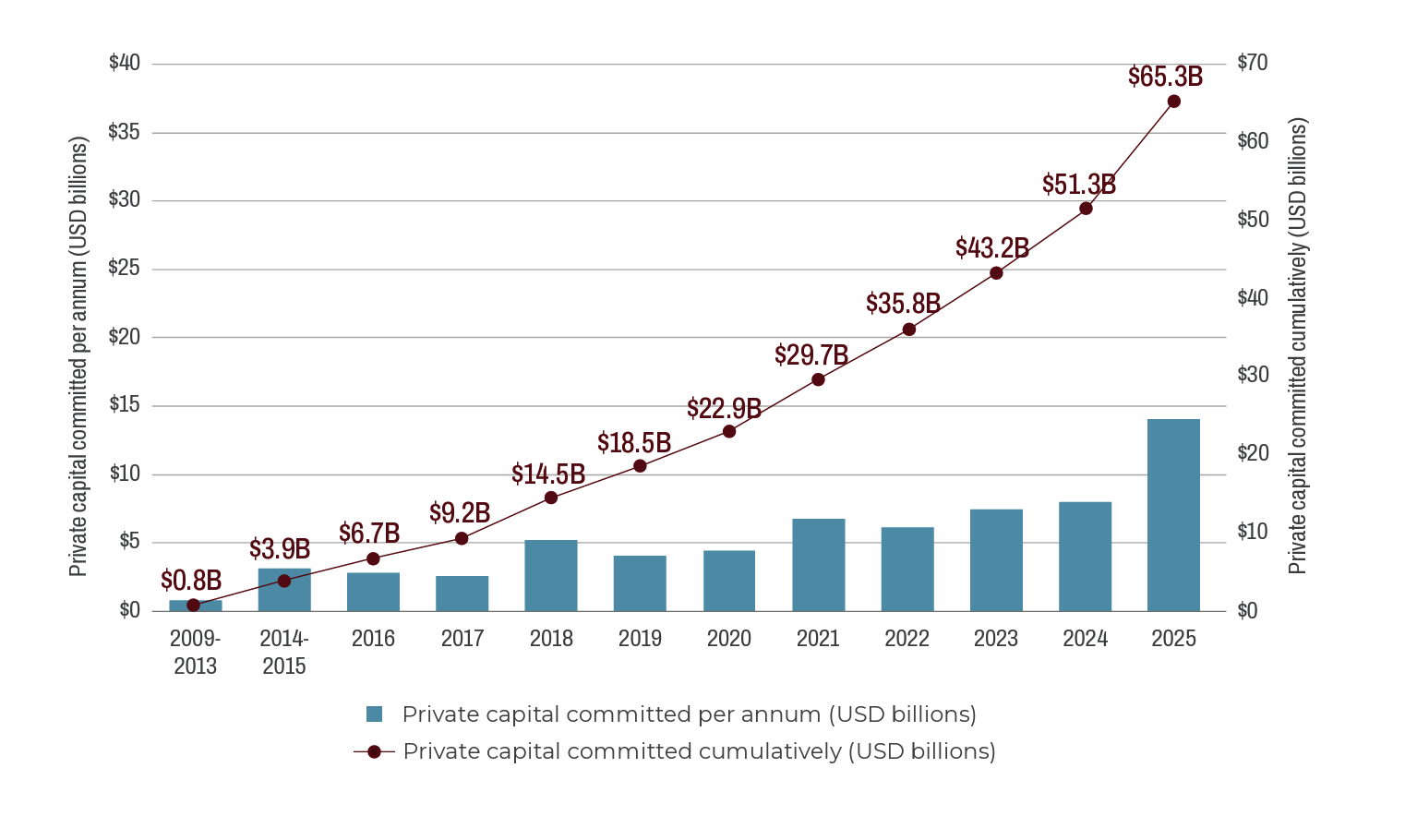
Source: Forest Trends’ Ecosystem Marketplace and The Nature Conservancy, Gaining Ground: State of Private Investment in Nature 2026
Gaining Ground analyzes an emerging investment theme that is growing, innovating, and attracting new large-scale funding, but is still constrained by the systems needed to deploy that capital efficiently.
Unlocking the next phase will depend on stronger enabling conditions that reduce risk and help capital flow more effectively. This is already taking shape through new standards and frameworks that help investors measure nature-positive outcomes, including the Taskforce on Nature-related Financial Disclosures. Government-backed markets, regulations, and disclosure requirements are also creating demand, from biodiversity credits to deforestation-free supply chains. At the same time, models such as water funds are demonstrating how investments in natural infrastructure can generate reliable revenue.
Overall, the analysis points to these approaches as a clear path for translating growing momentum into measurable impact capable of supporting resilient ecosystems and the communities and economies that depend on them.
“This report shows that institutional investors are investing in nature,” said Jennifer Morris, CEO of The Nature Conservancy. “Not surprisingly, investors are approaching the opportunity through sectors and markets they understand, which is exactly how a space like this develops. We also see new structures and approaches emerging to meet the expectations of investors—and translate into real investment activity. Increasing scale will require more durable policy signals and stronger demand for products like high-quality verified carbon and sustainably produced commodities.”
“The scale of capital reflected in these findings is significant,” said Michael Jenkins, CEO of Forest Trends. “But just as important is the type of investors now entering the space. We’re seeing a stronger presence of institutional capital who see that nature impact and financial performance can go hand-in-hand. Ten years ago, this was still a fairly niche category. Today, there’s a much broader set of nature-based activities that are viewed as viable and able to attract sustained capital. Tomorrow, the trajectory is toward nature firmly in the mainstream of finance, reflecting its centrality to a resilient global economy.”
Download the full report, Gaining Ground; State of Private Investment in Nature, 2026.
| For media inquiries, contact: Rachel Winters, Deputy Director, Global Media, The Nature Conservancy, Email: [email protected] |
The Nature Conservancy is a global conservation organization dedicated to conserving the lands and waters on which all life depends. Guided by science, we create innovative, on-the-ground solutions to our world’s toughest challenges so that nature and people can thrive together. We are tackling climate change, conserving lands, waters and oceans at an unprecedented scale, providing food and water sustainably and helping make cities more sustainable. The Nature Conservancy is working to make a lasting difference around the world in 81 countries and territories (40 by direct conservation impact and 41 through partners) through a collaborative approach that engages local communities, governments, the private sector, and other partners.
Forest Trends is a 501(c)(3) organization founded in 1999. Forest Trends works to conserve forests and other ecosystems through the creation and wide adoption of a broad range of environmental finance, markets, and other payment and incentive mechanisms. Forest Trends does so by 1) providing transparent information on ecosystem values, finance, and markets through knowledge acquisition, analysis, and dissemination; 2) convening diverse coalitions, partners, and communities of practice to promote environmental values and advance development of new markets and payment mechanisms; and 3) demonstrating successful tools, standards, and models of innovative finance for conservation.