Independent analysis of 1,055 companies using ICE data shows that 75% to 88% of emissions originate in supply chains, with leading firms reducing their emissions intensity, while many smaller and private companies lag behind.
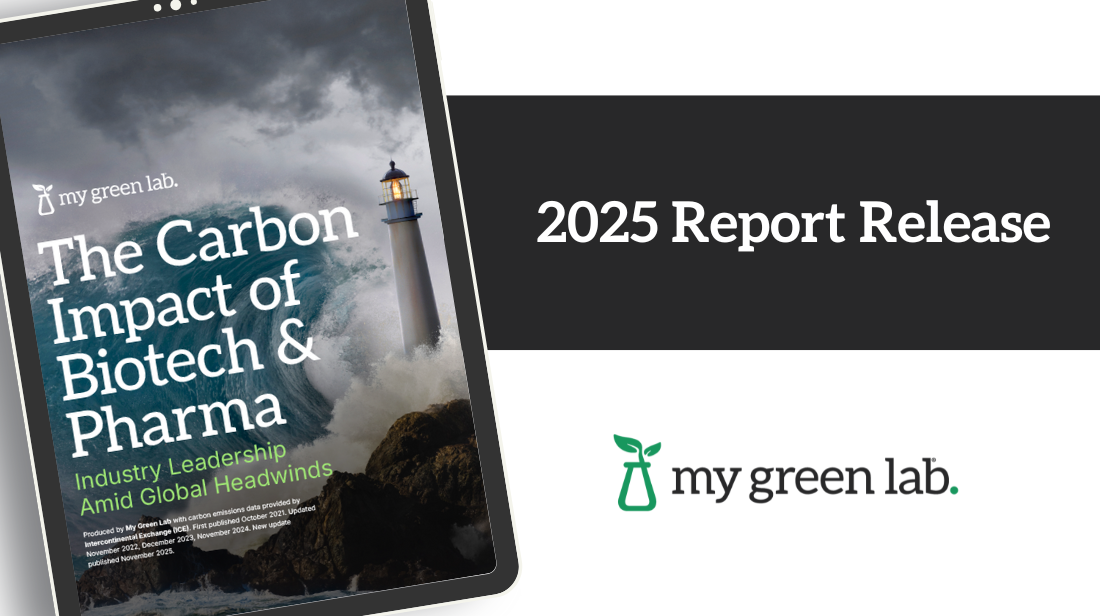
December 2, 2025 /3BL/ - My Green Lab, a global nonprofit dedicated to sustainability in science, today released its 2025 Carbon Impact of Biotech and Pharma Report in collaboration with Intercontinental Exchange (ICE). The report shows that the sector’s direct operations align with a 1.5-degree Celsius pathway, while supply chain emissions keep the total climate impact closer to 2 degrees and limit some of the progress made by the largest firms.
“Biotech and pharma companies are demonstrating that healthcare can expand while lowering the carbon footprint of their operations,” said James Connelly, CEO of My Green Lab. "Among the leaders in this report, we see operational emissions roughly aligned with a 1-degree Celsius pathway. Once supply chains are included, the sector still leans toward a near-2-degree Celsius rise. Most of the carbon remain in the value chain, and that is the part of the curve companies need to focus on next.”
The analysis uses ICE climate and financial data from 2019 to 2023 for 765 public companies and 290 private firms. These 1,055 companies together are responsible for an estimated 348 million metric tons of carbon dioxide equivalent in 2023 across Scopes 1 to 3, with about 224 million metric tons from public companies and 124 million metric tons from private firms. Scope 3 emissions account for approximately 75% of total emissions for public companies in the dataset and 88% for private companies, indicating that most of the sector’s climate impact comes from supply chains and other value-chain activities.
Key findings from the report include:
- The implied temperature increase for Scope 1 and 2 emissions is 1.04 degrees Celsius, aligning with a 1.5-degree pathway. When Scope 3 emissions are included, the implied temperature rises to 1.9 degrees, which is still above the level needed to meet Paris Agreement goals.
- Among the 146 companies with the highest-quality disclosures, 75.5% have set targets to reduce Scope 1 and 2 emissions. Within this group, 76 companies, or 52%, have medium-term Scope 1 and 2 targets for 2026 to 2035 that align with a 1.5-degree pathway. The report describes this as a tipping point for operational targets but notes that significantly fewer companies have Scope 3 targets with similar coverage and ambition.
- Since 2019, the 25 largest biotech and pharma companies by revenue have reduced emissions intensity for Scopes 1 and 2 by about 10%, and Scope 3 intensity by roughly 5%. Among the broader group of 243 other public companies, Scope 3 intensity has increased by 2% during the same period. For private companies, the top 25 have lowered Scope 3 emissions by approximately 3% over the past year, while the larger group of 290 private companies has seen a 6% rise in Scope 3 emissions.
“The analysis provides a forward-looking view of how transition risk is developing in this sector,” said Scott Weitze, VP of Research and Technical Standards at My Green Lab and a report co-author. “It shows clear progress on operational emissions at the top of the market and highlights areas where supply chain emissions and inconsistent disclosures still hinder the sector. That level of detail is what investors, regulators, and boards need to plan for the next decade.”
Despite existing gaps, the report shows that biotech and pharma remain among the most active sectors in the United Nations’ Race to Zero campaign. Currently, 42 major biotech, pharma, and medtech companies are members, up from 38 last year. Of these, 64% have launched a My Green Lab Certification program, and 63% of those programs operate globally. Leading companies including AstraZeneca, Biogen, and IQVIA have certified over 95% of their laboratories, meeting the sector's Breakthrough Outcome goal and demonstrating that green lab practices can expand from pilots to entire portfolios.
About My Green Lab
My Green Lab® is a nonprofit environmental organization with a mission to build a global culture of sustainability in science. The organization is the world leader in developing internationally recognized sustainability standards for laboratories and laboratory products—bringing sustainability to the community responsible for the world's life-changing medical and technical innovations. Laboratories are some of the most resource-intensive spaces in any industry, but they don't have to be. By introducing a new perspective and proven best practices within a carefully crafted framework, My Green Lab has inspired tens of thousands of scientists and lab professionals to make positive changes in their labs by reducing the environmental impact of their work.
For media requests, contact Christina Creager at [email protected].
For more information about My Green Lab, visit mygreenlab.org.