The second plenary of the GRI Global Conference explored the vast potential of private sector innovation and collaboration, and the role of government in supporting the breakthroughs needed to achieve the SDGs.
“It is a shameful truth that 850 million people still live in extreme poverty in the world, but the prospect of achieving the SDGs renews my faith in humanity,” declared Teresa Fogelberg, GRI Chief Executive, “The SDGs provide us with a moral compass. With new partnerships, a united commitment and a ‘can do’ attitude, we can achieve great things.”
The private sector plays a crucial role in helping countries meet the SDGs, and now, more than ever, there is a greater need for alignment, measurement and communication through the sustainability reporting process to enable a strong private sector contribution to the SDGs.
Ernesto Ciorra, Head of Innovation and Sustainability at Enel, focused on the need to think differently and introduced the concept of ‘innovability’: “Sustainability and innovation are more than just embedded in the business. They are the business.”
The multinational energy company, Enel, has been at the forefront of environmental and social sustainability. “We aren’t sustainable unless we innovate, and in order to innovate, we have to be sustainable,” explained Ernesto Ciorra, “Within companies, people respect the rules, and do not think differently. We need to shift paradigms. We need people to break the rules, and we need people with big ideas to innovate. We need to involve people from outside the company, outside the sector, in the form of international networks and greater collaboration.”
Governments and market regulators have been increasing their activity on policies to further the sustainable development agenda in recent years. Since 2013, the number of sustainability reporting instruments around the world has more than doubled, driven by strong growth in Europe, Asia Pacific and Latin America. This is a key finding from the 4th version of ‘Carrots & Sticks’, a joint publication by GRI, KPMG International, and The Centre for Corporate Governance in Africa, which was launched yesterday at the GRI Global Conference.
Linda Kromjong, Secretary-General, International Organization for Employers (IOE), urged governments to go further, to take the lead and ensure frameworks and national action plans (NAPs) are in place to allow for greater business contributions to the SDGs. “There are currently only a handful of NAPs worldwide. The UK and the Netherlands, for example have created plans, but these are not enough. NAPs set a framework in which the SDGs can fit.”
Along with the call on governments to do more, there was also a call for mobilizing the small and medium enterprises (SMEs) around the world. The sheer critical mass that SMEs represent within the business community offers great potential for effecting significant change in the sustainability landscape. GRI and IOE, the world’s largest private sector network, recently announced a partnership agreement outlining their intent to stimulate business action on sustainable development.
Linda Kromjong outlined two main hurdles to achieving the SDGs during the plenary: reaching the vast majority of SMEs that make up the business landscape (notably the small enterprises); and bridging cultures to reach organizations in, for example, the Gulf region, Latin America, and other places, where ‘forcing’ them to comply with regulations simply won’t work. “We need to push and support in a balanced manner,” urged Linda. “We need to team up. We will never be ‘issue free’, and we will never have a perfect world. But the way in which companies deal with the issues at hand will make them better employers.”
“Innovation is needed to reach every last child,” said Elisabeth Dahlin, Secretary-General, Save the Children Sweden. “The private sector can move quicker and smarter than other actors, and companies need to integrate children’s rights into their supply chains.” Elizabeth urged organizations to go beyond compliance and philanthropy, and to form true partnerships to help achieve the SDGs. “Companies need to step out of their comfort zones and be truly innovative.”
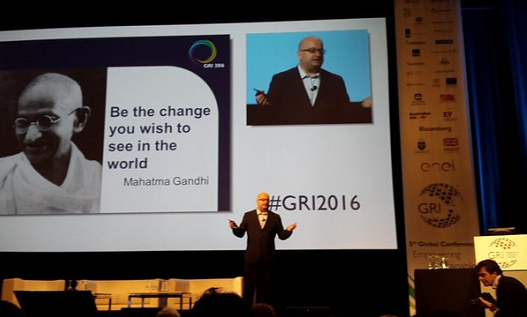
Enel’s Ernesto Ciorra called on all of us to make the change individually: “It is impossible to change if we don’t start that change from within ourselves. We too often forget to break the rules and forget to nurture creativity in companies. We should remember Gandhi’s famous quote, ‘Be the change you want to see in the world’.”
About GRI
GRI™ is an international independent organization that has pioneered corporate sustainability reporting since 1997. GRI helps businesses, governments and other organizations understand and communicate the impact of business on critical sustainability issues such as climate change, human rights, corruption and many others. With thousands of reporters in over 90 countries, GRI provides the world’s most trusted and widely used standards on sustainability reporting, enabling organizations and their stakeholders to make better decisions based on information that matters. Currently, 38 countries and regions reference GRI in their policies. GRI is built upon a unique multi-stakeholder principle, which ensures the participation and expertise of diverse stakeholders in the development of its standards. GRI’s mission is to empower decision-makers everywhere, through its standards and multi-stakeholder network, to take action towards a more sustainable economy and world.