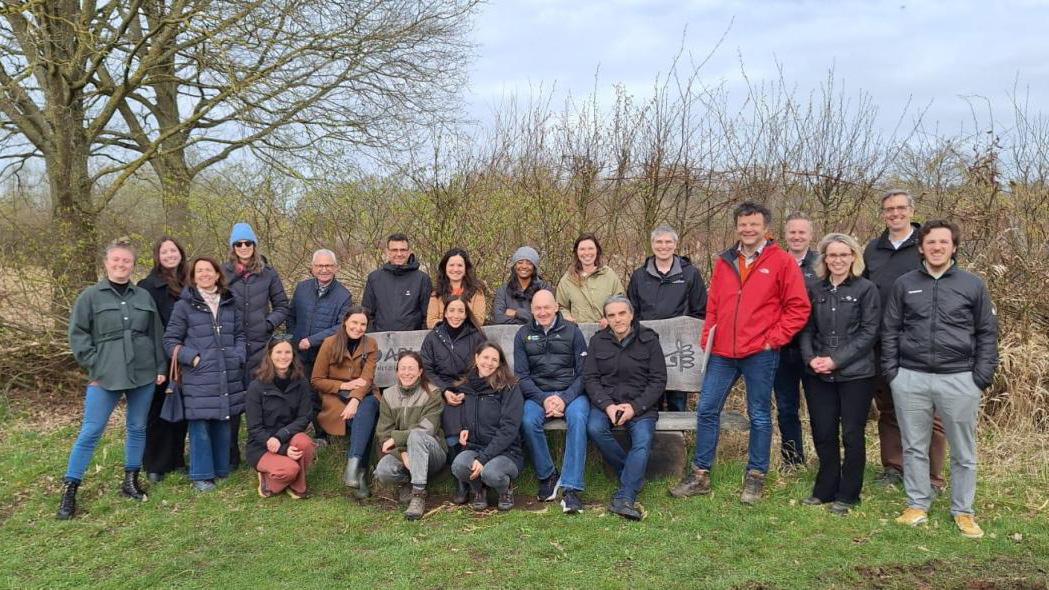
As BIER enters its 20th year, the Spring Roundtable in Leuven, Belgium, brought members together at a moment that feels both reflective and forward-looking.
Hosted by AB InBev, the Roundtable created space for what BIER has always done best: bringing industry leaders together in a pre-competitive environment to work through complex environmental challenges with honesty, rigor, and a shared commitment to progress.
That spirit was present throughout, not just in what was discussed but also in how members showed up: open, engaged, and willing to move beyond high-level ambition to practical, collective action.
Grounded in Reality: From Challenges to Action
The Roundtable opened with a clear focus on regenerative agriculture, recognizing real-world systems shaped by constraints, trade-offs, and competing priorities.
Members engaged directly with the challenges: supplier engagement, execution complexity, and the realities of scaling across diverse geographies. What emerged was a shared understanding of what is actually getting in the way. From there, the conversation shifted into action.
Small group discussions focused on co-creating practical approaches to address the most pressing challenges. This is where BIER’s model becomes tangible: scientific rigor paired with shared expertise, resulting in solutions that no single company could develop in isolation.
The dialogue then expanded to farmer wellbeing and zero-deforestation alignment: two areas where definitions, frameworks, and expectations continue to evolve. By examining leading approaches and early regulatory signals, members worked toward greater consistency, while also acknowledging where gaps remain.
Systems Thinking in Practice: Climate, Water, and Regulation
Day two reinforced that environmental challenges do not sit neatly in silos.
Discussions on water security highlighted the direct link between catchment-level stewardship and long-term business resilience. Members explored the trade-offs involved in managing water-related risks while maintaining growth and community trust, a balance that requires both technical understanding and practical decision-making.
On climate, the focus turned to the forthcoming updates to the SBTi Net-Zero Standard (V2.0) and the Greenhouse Gas Protocol’s land-sector guidance. These frameworks are actively shaping how companies measure, manage, and communicate emissions across increasingly complex value chains.
At the same time, regulatory developments, from the CSRD Omnibus to UK Sustainability Reporting Standards and California Climate Rules, underscored the importance of shared interpretation and alignment. In a rapidly evolving landscape, clarity is built through dialogue.
Emerging from these sessions was a shift from information-sharing to coordination, including refining how ideas are proposed, prioritized, and advanced to enable collective initiatives to scale effectively across the membership.
Leadership That Reflects the Moment
This year’s Roundtable also reflected the leadership guiding BIER into its next chapter.
We were pleased to welcome David Grant of PepsiCo and Harriet Cullum of Diageo as BIER’s 2026 Steering Committee Chair and Co-Chair, respectively.
David Grant steps into the role of Chair with a steady, pragmatic lens shaped by deep experience across BIER and the broader beverage sector. His focus on accountability, prioritization, and translating intention into measurable outcomes has already strengthened the organization’s approach to collective work.
Along with him, Harriet brings a systems-level perspective across water, agriculture, nature, and ESG performance, grounded in both corporate and not-for-profit experience. Her emphasis on data, transparency, and communication aligns closely with BIER’s approach and the increasing need to translate complexity into action.
Together, their leadership reflects clarity, discipline, and a continued commitment to meaningful collaboration.
From Roundtable to Resources: How the Work Moves Forward
The Roundtables, alongside BIER’s workstreams, are where shared challenges are surfaced, debated, and refined, and where the foundation is built for the tools and resources that support the broader membership.
From GHG guidance to water stewardship frameworks, benchmarking studies, and playbooks, BIER’s resources are shaped by the conversations and insights that emerge through this collective process.
This is how progress scales:
- Dialogue becomes alignment
- Alignment becomes guidance
- Guidance becomes action
And over time, that action becomes a measurable improvement across the sector.
20 Years of Collaboration — and What Comes Next
Established in 2006, BIER has spent two decades bringing globally recognized beverage companies together to improve environmental performance across water, climate, reporting, circularity, and nature.
What has remained consistent is the belief that no single company can solve these challenges alone.
The Spring 2026 Roundtable was a clear reflection of that; not just in the topics discussed, but in the willingness to engage, question, and move forward together.
As BIER enters its next chapter, the path ahead is not about more conversation for its own sake. It is about continuing to translate shared expertise into practical, science-based solutions that deliver real impact.