ESG due diligence has changed significantly over the last decade. What was once often treated as a narrower environmental or compliance exercise has grown into a broader business consideration touching operations, supply chains, resilience, reputation, and long-term value creation.
For businesses, investors, and property owners, that shift matters. ESG is no longer just about identifying what could go wrong. Increasingly, it is also about understanding where opportunities exist, how assets can become more resilient, and what actions will create value over time.
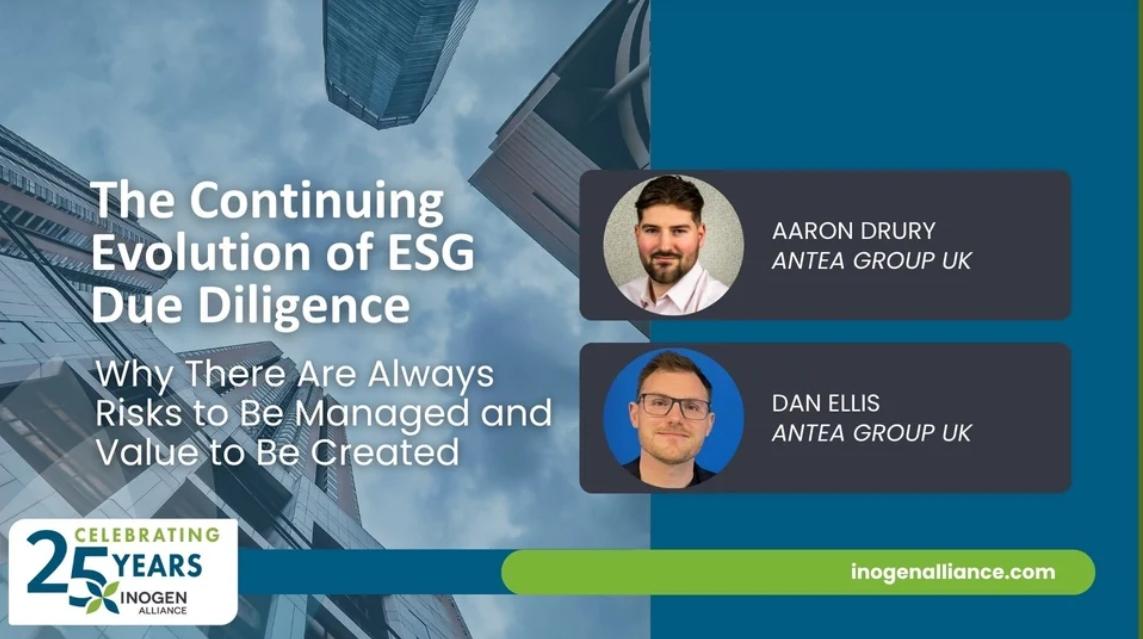
Through the global Inogen Alliance network, firms like Antea Group UK are helping companies navigate this evolving landscape by combining local expertise with global insight on sustainability and risk management. To explore how ESG due diligence is continuing to evolve, we spoke with Aaron Drury and Dan Ellis of Antea Group UK, who shared their perspectives on the drivers behind ESG risk assessment, the growing importance of resilience, and why ESG due diligence is increasingly about identifying opportunity as well as risk.
As Aaron Drury explains, “ESG is this opportunity to create value in your assets, but at the same time you don’t want to be caught out by an evolving legislative landscape.”
That balance between risk management and opportunity creation was a recurring theme throughout our discussion. Their perspective reflects how ESG due diligence is evolving in the UK and beyond, and why it remains an important part of good business decision-making, even as the language around ESG continues to shift.
ESG Due Diligence Is About More Than Compliance
From Dan’s perspective, the growth of ESG is rooted in a simple idea: “ESG is about doing good business.” He explained that it is about “being profitable whilst also generating value for the community in which you operate.”
That framing is important because it moves the conversation beyond reporting alone. While legislation and investor expectations are certainly part of the story, they are not the only drivers. Companies are also responding to changing expectations from employees, customers, and the public.
Dan noted that there is now much more awareness around what people want to see from the brands they buy from and the services they procure. In his words, “Buying patterns of customers are changing and, if you’re not practicing good ESG, customers can find out and move very easily”
Aaron pointed to both market expectations and regulation as major forces behind the shift. Resilient assets, he said, increasingly “command a better place in the market.” At the same time, legislation continues to evolve, particularly in the UK and across Europe, pushing investors and businesses to take a closer look at what they own, acquire, and operate.
From Broad ESG Strategies to Detailed, Practical Action
One of the clearest themes from the conversation was that ESG has matured.
Aaron noted that in many ways, environmental consultants were already doing this work long before the term ESG became mainstream: “We were doing ESG before it was called ESG.” What changed was that ESG became an umbrella term that pulled many disciplines together and gave investors and organizations a new way to frame these issues.
But like many fast-growing concepts, it also went through a period of oversimplification.
Aaron described the early response to ESG legislation and disclosure frameworks as something of a rush to define and package ESG quickly. He observed that “there was almost a bit of a gold mine rush to try and really understand what is ESG,” and that for a time there was “a real oversimplification towards trying to tackle ESG.”
Now, that is changing. Rather than staying at a high level, organizations are returning to the detail. Aaron described this as a shift “back to the detailed angle of ESG,” where the work may involve contaminated land due diligence, energy audits, health and safety compliance, supply chain issues, modern slavery policies, and more.
Dan described a similar evolution. ESG brought environmental, social, and governance disciplines together under one framework, creating a common language for what good performance could look like. That led many businesses to conduct materiality assessments and develop strategies. But the leading organizations have moved beyond that stage.
As Dan explained, “The forerunners of ESG are well beyond those stages now. They have their strategies — now it’s about implementation.”
That shift from strategy to implementation is a defining feature of ESG due diligence today.
Why Environmental Risks Still Dominate — But Social and Governance Risks Are Catching Up
Both Aaron and Dan acknowledged that, to date, the “E” in ESG has often received the greatest attention. Dan noted that environmental issues have often been easier to quantify, which made them more straightforward to measure and report on. But he also emphasized that social and governance issues are catching up quickly.
In fact, some of the less tangible elements may be among the most important. Reputation, workforce culture, supply chain practices, and governance structures can all have significant business impacts, even when they are harder to capture in a spreadsheet.
That broader lens is increasingly important in due diligence because the risks businesses face are interconnected. Organizations may still think first about compliance or reporting, but ESG risks can affect operations, investment performance, public perception, and future growth.
Physical Climate Risk Is Rising Fast
Among the most commonly overlooked areas, Dan pointed to is physical climate risk.
He explained that in the UK, flooding remains the most significant physical climate threat and is becoming more frequent and severe. But flooding is only part of the picture. Storms, wind damage, and heatwaves are also becoming more relevant.
As Dan put it, “We’re starting to see things like heatwaves becoming a real issue in the UK.”
He noted that once temperatures move into the high 30s and above 40 degrees Celsius, buildings and infrastructure begin to behave differently. Surface materials can degrade, coatings can fail, and flammable compounds may become more hazardous. For some businesses, that changes not only building performance, but also fire risk assessments and operational controls.
This is a good example of how climate risk is no longer a distant or abstract ESG issue. It is becoming an immediate operational and investment concern.
Energy Performance, Asset Resilience, and the Business Case for Action
Energy was another major theme in the discussion, especially in relation to real estate and investment due diligence.
Aaron stressed the importance of using reliable energy data, particularly when investors are making decisions about retrofits, capital expenditures, and long-term asset value. In the UK, Energy Performance Certificates and minimum energy efficiency standards play an important role in shaping expectations, but Aaron cautioned that theoretical or inconsistent data can lead to poor decisions.
The bigger point was that energy performance is not just a compliance issue — it is a resilience issue.
Dan explained that buildings aligned with a 1.5-degree net zero pathway are increasingly attractive because tenants want them. Corporates are looking for buildings that support their own sustainability goals, reduce energy costs, and offer more protection from fossil fuel price volatility.
Aaron summed it up well: “Energy is the hot topic in this respect.” He added that if a business is investing in energy efficiency, better-performing buildings, or renewable technologies, “you’re priming yourself for a much more resilient future.”
Dan shared that he has seen organizations that have invested in solar, wind, lower-carbon fuels, and other resilience measures become much more confident in forecasting future operating costs. In some cases, companies are even supporting their suppliers to make similar changes, recognizing that supply chain resilience also affects their own performance.
PFAS and Emerging Contaminants Are Becoming More Important in Due Diligence
The conversation also touched on PFAS and the growing importance of emerging contaminants in ESG and environmental due diligence.
Aaron acknowledged that the UK may be somewhat behind some European markets in this area, but made clear that PFAS is an issue that is continuing to evolve. Dan added an especially important due diligence point: liability is not limited to the original polluter - it transfers with land ownership
As he explained, “It doesn’t matter whether they created that pollution or not — it’s now their problem.”
That is a critical consideration for landowners, investors, and businesses acquiring or operating sites with historical uses that may have involved PFAS or other contaminants. Today’s due diligence decisions need to consider not only current operations, but also historical conditions that could create future liabilities.
Supply Chains, Social Risk, and Reputation Matter More Than Ever
While environmental topics dominated much of the discussion, Dan and Aaron also highlighted the growing importance of the social dimension of ESG due diligence.
Dan noted that understanding supply chains is about more than reducing operational or legal risk. It is also about understanding where materials come from, how work is performed across the value chain, and whether suppliers are operating in line with expected standards.
This is becoming more important as legislation evolves. Dan pointed to the EU deforestation regulation as an example of how due diligence obligations now extend deeply into the supply chain. If companies cannot demonstrate where their raw materials come from and show that they are not contributing to deforestation, they may lose market access.
In Dan’s words, “If you can’t do your due diligence, you might not be able to operate in certain markets.”
On the social side, Aaron reflected on how the workplace has changed since COVID-19. Commuting patterns, flexible working, and expectations around work-life balance have all shifted. Cities are also changing, with measures such as ultra-low emission zones altering how people move and work.
Those changes matter in due diligence because they affect how attractive, functional, and resilient an asset or business will be in the future. Aaron noted that if organizations are improving assets in ways that support local communities and better ways of working, “it just makes the asset more resilient as a whole.”
The Role of AI: Faster Data, But Not Better Judgment on Its Own
AI was another important topic in the discussion, particularly given the growing amount of ESG data available today.
Dan said clearly that AI is already changing the ESG landscape. Tasks that consultants once handled manually can now be automated, making data collection and analysis faster. But the real question is what businesses do with that information.
As Dan explained, “The element that AI currently doesn’t do is tell you what is right for your business and your culture.”
That is especially important in ESG, where decisions often involve trade-offs. A solution that improves one issue may create challenges somewhere else. Consultants still play a key role in helping businesses understand those trade-offs, apply local knowledge, and decide what makes sense in context.
Aaron took a similar view. “AI is going to change everything,” he said. “It’s going to make our lives easier, but it will always be a tool.” He emphasized that ESG is too broad and complex to be reduced to automation alone, and that something essential remains human: “That’s something AI will never be able to replace: a relationship.”
That point feels especially relevant in due diligence, where trust, judgment, and local understanding are central to good advice.
Practical Advice for Organizations Still Early in Their ESG Journey
For businesses that are still early in their ESG journey, Aaron offered reassuring and practical advice.
His first recommendation was simple: “The first step is just to pick up the phone.”
He acknowledged that ESG can feel overwhelming because of the number of service lines, standards, and topics involved. But not every organization needs to do everything at once. Often, a high-level review is enough to identify the issues that matter most now and the issues that may become more important later.
As Aaron put it, “If you’re thinking about ESG, that’s a great thing. If you’re already thinking about it, you’re already halfway there.”
Dan also stressed that businesses do not need to overcomplicate the process. There are now many good tools and frameworks available to help identify the most relevant ESG topics by industry. For smaller and mid-sized organizations, even a relatively simple materiality exercise can provide enough clarity to begin building a roadmap.
He also made an important organizational point: ESG should not sit off to the side as a completely separate function. Over time, sustainability and ESG responsibilities have become more integrated into finance, operations, procurement, and leadership roles. Rather than treating ESG as someone else’s job, companies should look at the capabilities they already have and build from there.
The Future of ESG Due Diligence: From Risk Identification to Opportunity Creation
Looking ahead, both Aaron and Dan expect ESG due diligence to continue evolving in a more practical, integrated direction.
Aaron emphasized the importance of trusted networks and cross-disciplinary collaboration. Particularly in areas like real estate, energy, and technical building performance, no single discipline has all the answers. The future, he said, lies in bringing together strong partners who can deliver meaningful, realistic advice.
Dan, meanwhile, described the future of ESG due diligence as going “beyond just risk mitigation.” Risk assessment remains important, but more clients are now asking what can be improved, what value can be unlocked, and what plans exists to move an asset or organization from where it is today to where it needs to be.
That is a meaningful change. Rather than using due diligence only to avoid problems, more organizations are using it to understand potential, prioritize actions, and guide investment.
Dan also pointed to the value of more holistic thinking. Instead of treating energy, nature, water, and social impact as separate issues managed by separate teams, he sees greater value in integrated solutions that deliver multiple benefits at once.
ESG Is Still About Good Business
Although ESG has faced some pushback in recent years, neither Aaron nor Dan sees that as a sign of decline. Instead, they see a field that is being refined and becoming more grounded in practical outcomes.
Aaron put it plainly: “There is real value to be created here through risk management or genuine opportunity.”
Dan returned to the broader principle at the heart of the discussion: ESG is not going away because, fundamentally, it is still about doing good business. It may be framed differently depending on the audience — risk, resilience, value, cost savings, supply chain stability, employee wellbeing, or reputation — but the underlying issues remain.
And perhaps the strongest closing thought came from Dan, who said: “There are so many opportunities to make people’s lives better and make some money along the way. But if you dawdle and decide not to pursue some of those opportunities, someone else will.”
That may be one of the clearest ways to understand the continuing evolution of ESG due diligence today. It is still about risk. It is still about compliance. But increasingly, it is also about resilience, foresight, and the ability to create value in a changing world.
Get in touch for support on your ESG and EHS due diligence!
Inogen Alliance is a global network made up of over 70 of independent local businesses and over 6,000 consultants around the world who can help make your project a success. Our Associates collaborate closely to serve multinational corporations, government agencies, and nonprofit organizations, and we share knowledge and industry experience to provide the highest quality service to our clients. If you want to learn more about how you can work with Inogen Alliance, you can explore our Associates or Contact Us. Watch for more News & Blog updates, listen to our podcast and follow us on LinkedIn.