Imagine trying to understand a complex health condition while feeling overwhelmed, uncertain, and alone. In Canada, two new digital tools are helping people navigate vascular and cardio-renal-metabolic conditions with clarity, privacy, and confidence. Designed around real needs, these platforms show how digital innovation can help close gaps in health equity.
It started with a question. Late one evening in rural Quebec, a woman recently diagnosed with peripheral artery disease sat at her kitchen table, overwhelmed and unsure where to turn. Her doctor had explained the condition, but the words blurred under the weight of fear. She needed answers, clear ones, in her language, without medical jargon or judgment. She opened her laptop and typed a question into a new tool she had heard about through the Vascular Health Portal: “What does peripheral artery disease mean for me?”
The response came instantly. It was calm, clear, and reassuring. It came from Amélia.
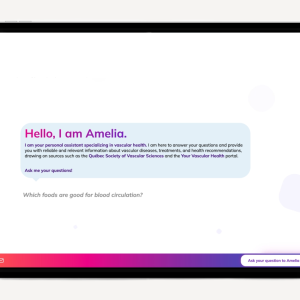
Developed by the Quebec Society of Vascular Sciences (QSVS) in partnership with Boehringer Ingelheim Canada, Amélia is a conversational digital assistant designed to help people navigate vascular health with confidence. More than a chatbot, it serves as a bridge between questions and understanding, between patients and credible information, and between healthcare systems and the communities they serve.
In a healthcare environment under increasing strain, tools like Amélia reflect a growing recognition that sustainability is not only about environmental impact, but also about building resilient, accessible health systems that work for everyone.
Health equity as a pillar of sustainability
Canada’s aging population is facing a growing burden of vascular disease—conditions that can be life-threatening if left undiagnosed or poorly understood. Yet access to timely, accurate, and digestible health information remains uneven, particularly in rural and underserved communities.
Amélia was designed to help close this gap. The digital assistant provides 24/7 access to expert-guided vascular health information in both English and French. It does not require users to input personal data, preserving privacy while delivering clarity. And it meets people where they are, whether at home, in a clinic, or on a mobile device during a lunch break.
Boehringer aims to improve digital health literacy, which too often creates barriers for accessible healthcare: By supporting digital tools like Amélia, we’re investing in long-term health outcomes, helping reduce preventable disease burden, and contributing to a more inclusive healthcare landscape.

Digital health literacy is no longer just an asset—it’s becoming essential for a resilient healthcare system.
Dr. Michel Vallée, Nephrologist and President of QSVS
A vision for connected care
Hundreds of kilometers away, in the heart of Toronto, another innovation is taking shape at the University Health Network (UHN), home to Toronto General Hospital, ranked among the top hospitals globally. Here, Boehringer Ingelheim and UHN are expanding their collaboration to address cardio-renal-metabolic (CRM) conditions, where heart, kidney, and metabolic disorders intersect. These conditions are increasingly prevalent and among the most complex to manage, often requiring coordinated care across multiple specialties.
This partnership is designing Medly CRM, a digital platform to connect care across specialties. Building on the success of the original Medly program for heart failure patients, Medly CRM aims to integrate real-time data, virtual support, and proactive clinical interventions. Its goal: to reduce hospitalizations, improve coordination, and create a more sustainable model for chronic disease management.
For patients, this technology has the potential to reduce fragmented appointments and to improve more personalized care. For clinicians, it may enable better access to data and streamlined workflows. And for the healthcare system, it has the potential to enhance efficiency, strengthen resilience, and reduce environmental impact.
Innovation with purpose
While Amélia and Medly CRM address different stages of the patient journey, they share a common foundation: innovation designed with intent.
By reducing unnecessary travel, supporting care from home, and strengthening coordination across the system, these digital tools contribute to improved outcomes while also lowering environmental impact. This is particularly relevant as healthcare systems face increasing pressure from rising demand, constrained resources, and climate considerations.
CRM conditions are among the leading drivers of hospital admissions and healthcare costs in Canada. Cardiovascular diseases alone cost the Canadian economy more than $21 billion annually. In this context, digital solutions like Amélia and Medly CRM are not simply technological enhancements—they are strategic responses to systemic challenges.
- Cardiovascular disease costs Canada every year CAD > 21B. The digital assistants Amélia and Medly CRM help support physicians and connect patients to care.
Technology with a human touch
“What makes these tools powerful isn’t just their functionality—it’s their humanity,” says Dr. Rasha Eldesouky Abouelabbas, Vice President, Medical and Regulatory Affairs Boehringer Ingelheim Canada.
Amélia does not replace healthcare providers; it complements them. By helping patients understand their condition, prepare questions, and navigate medical information, it supports more informed conversations and reduces the burden of misinformation. Users can print or email their conversations for future reference, helping them prepare for appointments or share insights with caregivers.
Medly CRM similarly focuses on empowerment. By providing real-time insights and enabling closer collaboration between patients and care teams, its goal is to shift chronic disease management from reactive treatment to active partnership.
Building a more sustainable healthcare system
For Boehringer, these initiatives are more than pilots. They are proof points that sustainability can be embedded directly into healthcare innovation—aligning health equity, digital transformation, and climate-conscious care delivery. By reducing hospital visits, enabling remote care, and supporting informed decision-making, Amélia and Medly CRM contribute to healthier people and a more resilient healthcare system.
And this is only the beginning. Their success highlights a broader opportunity to apply digital and AI-enabled solutions across other chronic conditions—advancing a model of care that is inclusive, sustainable, and built around the needs of patients and providers alike.
Our commitment
By 2030, we aim to expand access to healthcare for 50 million people, investing 35 billion EUR in health innovation and research to tackle non-communicable diseases and an additional 250 million EUR in partnerships to combat emerging infectious diseases. To achieve these ambitious goals, we partner with leading healthcare organizations that share our commitment.
About University Health Network (UHN)
UHN is Canada’s hospital. With 10 sites and more than 44,000 TeamUHN members, UHN consists of Toronto General Hospital, Toronto Western Hospital, Princess Margaret Cancer Centre, Toronto Rehabilitation Institute, The Michener Institute of Education and West Park Healthcare Centre. UHN has the largest hospital-based research program in Canada, with major research in neurosciences, cardiology, transplantation, oncology, surgical innovation, infectious diseases, genomic medicine and rehabilitation medicine. UHN is a research hospital affiliated with the University of Toronto. www.uhn.ca
About the Quebec Society of Vascular Sciences (QSVS)
The QSVS is a charitable organization dedicated to fostering professional exchange among a variety of healthcare professionals (family physicians, specialists, nurses, pharmacists, nutritionists, and more) and informing the public about vascular health. Through initiatives like the www.yourvascularhealth.ca portal and Amélia, the QSVS promotes research, innovation, and excellence in patient care across Quebec and Canada.
Read more on Imagine – Boehringer Ingelheim’s sustainability story hub.
*Image credits: Header picture, content video, and static illustrations: Boehringer Ingelheim. Quote picture: Paul Ducharme, photographe.
Additional Media
Videos