Geoff Martha, Medtronic chairman and CEO and Dennis Pullin, Virtua Health president and CEO, on an innovative partnership that improves chronic disease outcomes and rebuilds trust in healthcare
Across the U.S., millions of people face growing barriers to accessing healthcare, driven by lack of insurance, policy changes, and systemic inequities that leave entire communities underserved. These challenges are not new, nor are they limited to the United States, but they are intensifying and they demand new models of care.
In Camden, New Jersey, where nearly 20% of residents are uninsured and life expectancy varies by 16 years across just a few miles, the urgency is especially clear. This isn’t just a statistic in a report; it is a call to action.
Faced with this stark data, Virtua Health and Medtronic saw an opportunity to do more than business as usual. Combining Virtua's deep community roots with Medtronic LABS' global experience in tech-enabled, community-based care, Healthy Neighbor was born.
This collaboration is more than a local initiative – it's a test case that highlights how the healthcare industry can improve health outcomes in the communities that need it most.
Virtua’s community-first approach
Dennis: Virtua Health is South Jersey's largest healthcare provider, serving a region marked by profound health disparities. Over decades, we invested in mobile health programs, from a grocery store on wheels stocked with nutritious food to custom-designed vehicles that offer cancer screenings and pediatric care.
But proximity alone wasn't sufficient. We recognized a large opportunity to improve access to care for the region's most vulnerable patients, namely, those who were uninsured, disengaged, or distrustful of the healthcare system. Our "Here for Good" philosophy prompted us to confront uncomfortable truths about who was left behind and why.
We made the strategic decision to treat community health as a core service line, on par with cardiology or oncology. This was a moral imperative – and it was also a sound business strategy to reduce costly emergency care by preventing illness upstream.
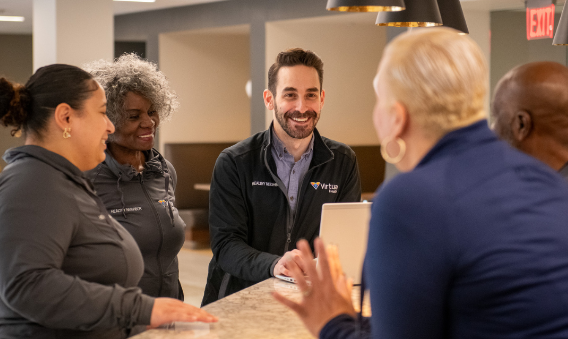
We designed Healthy Neighbor to address the full context of patients' lives. Community health workers (CHWs) provide home visits, support for social needs, targeted health education, and consistent follow-up to create the foundational trust necessary for long-term behavior change. Our CHWs go out of their way, literally and figuratively, for patients.
One patient, Bill Adams*, initially questioned whether his CHW would even show up. He had no health insurance and little trust in the healthcare system in general. But Karen showed up at his home, took his blood pressure, and discovered it was dangerously elevated. She connected him to emergency care the same day.
"Thank you so much for coming to my home," Bill told her afterward. "You saved my life."
That story encapsulates what differentiates this model: relationships built on consistency, presence, and genuine care create the conditions where clinical interventions actually work.
A U.S. debut for Medtronic LABS
Geoff: Medtronic LABS has a decade of experience delivering community-based, tech-enabled care in countries around the world, including in Kenya, Ghana, Sierra Leone, and Bangladesh. With 8,000+ community health workers trained and over 1 million patients reached, we have frameworks, tools, and credibility to help scale a new model, but had never built a program in the United States.
When we first met with Virtua leadership, we recognized an exceptional opportunity to build a program together. Our role extended beyond providing tools. We helped translate global best practices into a U.S. context, proving that tech-enabled care can be both deeply personal and genuinely scalable.
We adapted SPICE, an open-source digital health platform, for U.S. healthcare systems to ensure it met HIPAA data privacy standards and incorporated social determinants of health screening. Critically, SPICE was redesigned with CHW input to ensure the technology enhanced rather than hindered the human relationships at the heart of the program.
Simple workflows guide CHW screening, enrollment, and patient assessments. Immediate, automatic alerts flag out-of-range blood pressure and glucose values and provide clear follow-up steps. Risk-based stratification guides clinical review. Real-time dashboards enable program monitoring and rapid identification of opportunities to better serve participants. Technology is the enabler, but people are the core.
For Medtronic, Healthy Neighbor reflects our Mission to alleviate pain, restore health, and extend life. It advances our goals while positioning us as more than a device manufacturer but also as an essential partner in the care ecosystem.
From pilot to blueprint
In its first two years, Healthy Neighbor enrolled more than 250 individuals facing a wide range of health and social care needs. Over half live with multiple chronic conditions and had visited the ER in the past year.
The clinical outcomes are exceptional: 74% of patients with uncontrolled hypertension saw an average 15-point drop in systolic blood pressure, while 69% of those with uncontrolled diabetes reduced HbA1c (blood sugar) by 1.2%. Yet numbers only tell part of the story. Patients consistently credit community health workers for their persistence and care – the trust that makes change possible.
From the outset, Healthy Neighbor was designed for scale. A comprehensive toolkit, covering workflows, protocols, and lessons learned, helps other organizations adopt the model. With multiple entry points across primary care, emergency departments, and community settings, plus a modular tech platform, the program can be tailored to different populations and geographies.
While scaling nationally will require systemic changes – including funding for CHWs, payment models that reward prevention, and policy support – healthcare leaders don’t need to wait: the blueprint is here, and the results are remarkable.
Collaboration as a catalyst for scalable change
Healthy Neighbor began with a challenge: Could we change health outcomes if we met patients where they are and valued them as individuals?
Through community-based and tech-enabled care, we’ve created a replicable model that improves chronic disease outcomes and rebuilds trust in healthcare. The remaining barrier is leadership commitment. Health systems must assess local needs, find mission-aligned partners, and invest in long-term, trust-based solutions.
The lesson from our experience is clear: Community health must be treated as a strategic investment, not a charitable add-on. It also proves that the healthiest communities are built on relationships – and the time to build them is now.
*Name changed to protect patient privacy
Additional Media
Images