Medtronic delivers business value through product and packaging improvements that conserve natural resources, increase recyclability, and help minimize emissions and waste.
You just got a package delivered! You can’t wait to try out your new [insert item here: sneakers, coffee maker, backpack, etc.]. But to get to your new item, you must go through two boxes and endless packing material. It takes forever, and then you are left with a mountain of trash. All for one item.
This experience feels almost universal these days, and the healthcare technology industry is no exception. At Medtronic, we consistently hear from customers worldwide that they want products and packaging to: weigh less, generate less waste, be more recyclable, and incorporate recycled materials wherever possible.
So, what are we doing about it?
Integrating eco-design in our work
We know that being less wasteful is critical to protect the planet’s finite resources for future generations. And sustainability creates business value, delivering enduring value to patients, customers, investors, and employees.
Medtronic formed a team, a dedicated sustainability engineering group, to drive product and packaging innovations that meet these needs. Our efforts focus on:
- Right-sizing packaging
- Reducing or eliminating unnecessary materials
- Introducing recycle-ready1 materials when possible
- Designing packaging to be lighter, thinner, smaller, and less voluminous
These innovations not only reduce environmental impact but also help us operate more efficiently. They allow for packaged products to be arranged more efficiently, increasing parcel densities, consolidating shipments, and enabling opportunities for packaging automation. Additionally, when possible, we incorporate materials that are reusable, recyclable, made from recycled content, or derived from bio-based alternatives.
Partnering with healthcare systems to reduce medical waste
We partner with healthcare systems and industries to explore how we can increase sustainable practices within hospitals. This means using resources more efficiently and reducing waste, and includes efforts such as:
- Moving from paper instruction manuals to digital manuals: all of our products used to include paper instruction manuals, and we are working with stakeholders globally to change regulations to remove the paper manual requirement and move to digital manuals. When this move is complete, we estimate that it will save a minimum of 2,000 tons of paper by FY30.
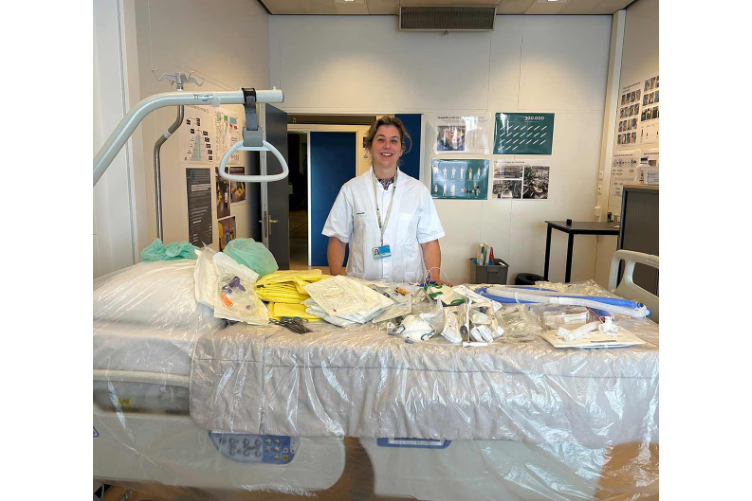
- Evidence-based Strategies to create Circular Hospitals (ESCH-R): Applying the 10-Rs framework to healthcare is an interdisciplinary project funded by the Dutch Research Council and Medtronic. The project is exploring opportunities to replace single-use plastic consumables, reduce demand on virgin materials, cut CO2 emissions, and transition to a more circular health system. In the first year of the project’s five-year span, researchers explored opportunities to embed circularity into the design of oximeters and needle catheters through innovative approaches to product design, material use, and disposal.
Exploring new opportunities to reduce, reuse, and recycle
Our engineers are designing products to minimize waste by developing smaller products (meaning less waste), extending product lifespans, so devices are used longer and replaced less often, and removing unnecessary components.
An example of this last point is a project that the team worked closely on with a team of product engineers in our Medical Surgical portfolio. Together, the teams removed a seldom used accessory tool from a surgical stapling device. Research revealed that the accessory was rarely used and was just discarded in most cases. Removing the component will save over 1.5 tons of material from landfills each year and improve supply chain resilience.
In our Materials Research Lab, we are investigating new materials that can be more easily recycled and are better for the environment. This takes creativity and exploration into new materials from other industries that are less carbon intensive. Using materials that are readily recyclable or bio-derived embeds sustainability into our products and packaging from the start and reduces their environmental impact.
Innovating for sustainability
The examples above are just the beginning. By FY30, circularity criteria will be embedded in all product developments at Medtronic. This means that all new devices will have design considerations to minimize environmental impact.
Our dedicated sustainability engineering team is helping to increase sustainability across Medtronic, but circularity and sustainability aren’t the responsibility of just one team. We encourage employees around the world to look for new ways to optimize packaging, manufacturing, shipping, and product life cycles. This work is critical to protect our planet for future generations.
Learn more about our efforts to minimize our environmental impact at Medtronic.