As the United States prepares to celebrate its 250th anniversary, researchers are using cutting-edge technology to preserve one of the nation’s most enduring symbols: the Liberty Bell.
By Eric Ellis, Higher Education Strategist NA
As the United States prepares to celebrate its 250th anniversary, researchers are using cutting-edge technology to preserve one of the nation’s most enduring symbols: the Liberty Bell.
In partnership with the National Park Service and the VAR Lab at Penn State Behrend recently completed what is believed to be one of the most comprehensive digital preservation efforts ever undertaken for the Liberty Bell. The resulting high-fidelity digital model will help preserve the historic artifact for future generations while expanding opportunities for research, education and public access.
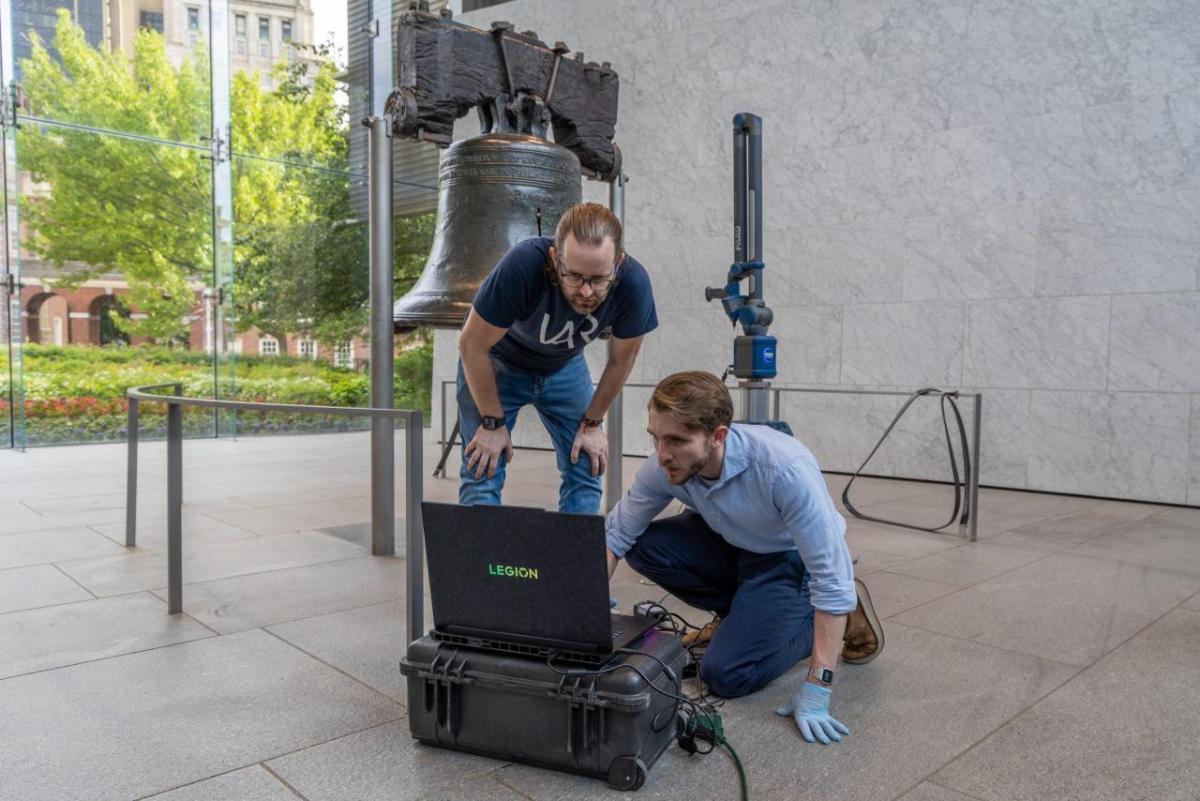
Using laser-line and structured-light scanning, LiDAR, and photogrammetry capable of capturing details as small as 10-25 microns—less than half the width of a human hair—the team created multiple research-grade digital models of the bell without ever touching, moving or altering the historic artifact.

The project was completed during a tightly controlled nine-hour access window over two days at the Liberty Bell Center in Philadelphia. Working before and after public visiting hours, researchers deployed an extensive suite of scanning equipment to capture the bell and its surroundings from virtually every possible angle.
To support the effort, Lenovo provided a Lenovo Legion system that enabled researchers to process and validate massive scan datasets onsite, helping ensure data quality during the limited access window. The system also supported visualization, quality assurance and media workflows throughout the project.
“Having the Lenovo Legion system with us in Philadelphia made a real difference for the field workflow,” said Christopher R. Shelton, Ph.D., Founder and Director, VAR Lab (The Emerging Technologies Hub). “It gave the team more flexibility during a very limited access window and helped us manage onsite processing, quality assurance, visualization and media work in a way that would have been much harder without it.”
The digital model will serve as a permanent archival record while also being made broadly available for education, research and public engagement through interactive digital experiences. The work also lays the foundation for future research, including acoustic simulations that could help answer a longstanding question: What would the Liberty Bell sound like if it were rung today in its current cracked state?
“As we approach America’s Semiquincentennial, technology is creating entirely new ways to preserve, study and experience our shared history,” said Milo Speranzo, Chief Marketing Officer, Lenovo North America. “We’re proud Lenovo technology helped support the creation of a high-fidelity digital record of the Liberty Bell that can benefit researchers, educators and future generations.”
Future phases of the project may also include creating a full-scale 3D-printed replica capable of recreating the bell’s sound for educational experiences, further demonstrating how advanced computing, AI and digital preservation technologies can help protect and share cultural heritage.
By helping researchers preserve and study an irreplaceable piece of American history, Lenovo technology is demonstrating how innovation can help safeguard our shared heritage for generations to come.