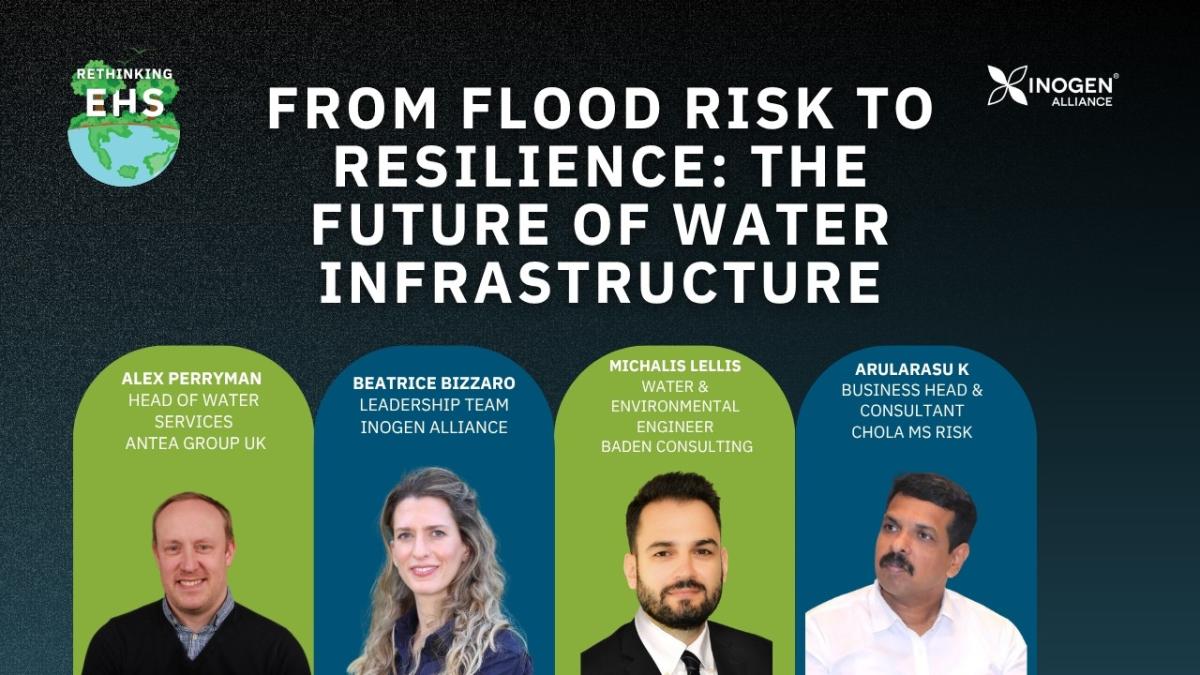
In this episode, host Beatrice Bizzaro (HPC Italy, Inogen Alliance Global Water Working Group Lead) is joined by Alex Perryman from Antea Group UK, Arularasu K from Chola MS Risk in India and Michalis Lellis from Baden Consulting in Switzerland to explore how organisations are approaching water-related infrastructure resilience as climate conditions become less predictable.
The discussion spans flooding, drought and water scarcity, intense rainfall, glacier melt and slope instability, and examines how these risks are changing the assumptions that infrastructure owners and planners use to design and protect critical assets.
Listen Now
Time Stamps
- 00:00:02 – Introduction: Water infrastructure resilience in a changing climate
- 00:01:21 – UK water risk: Flooding, scarcity and water stewardship
- 00:02:55 – India: Extreme rainfall and urban flooding
- 00:03:25 – Switzerland: Rainfall, glacier melt and infrastructure resilience
- 00:04:41 – Rethinking historical design assumptions and stationarity
- 00:06:04 – Nature-based solutions, sponge cities and stronger regulation
- 00:07:11 – Cascading risks across interconnected infrastructure systems
- 00:09:07 – Surface water, river and coastal flood risk in the UK
- 00:12:11 – Building long-term, holistic resilience
- 00:13:46 – Critical infrastructure vulnerabilities and connected systems
- 00:17:02 – Lessons from failures, drainage limits and fragmented governance
- 00:20:27 – Flood modelling, AI and nature-based innovation
- 00:22:38 – Digital twins, data sharing and smart dam management
- 00:24:39 – Multinational resilience planning and local priorities
- 00:27:47 – Learning across regions: Netherlands, Asia and the UK
- 00:30:45 – India: Digital twins, satellite data and sponge cities
- 00:31:59 – The business case for resilience and supply-chain risk
- 00:34:11 – Switzerland: Long-term planning and local knowledge
- 00:35:17 – Future trends: AI forecasting, climate scenarios and pre-event planning
- 00:38:32 – Closing reflections and future outlook
Guest Quotes
Alex Perryman:
“So I'd say in the UK we're talking about the whole spectrum, like too much water, too little water and everything in between and the quality of it, the availability of it, how efficiently we use it and how we reuse it even as a resource.”
Michalis Lellis:
“Climate conditions are changing and infrastructure that was once considered resilient may no longer provide the same level of protection in the future.”