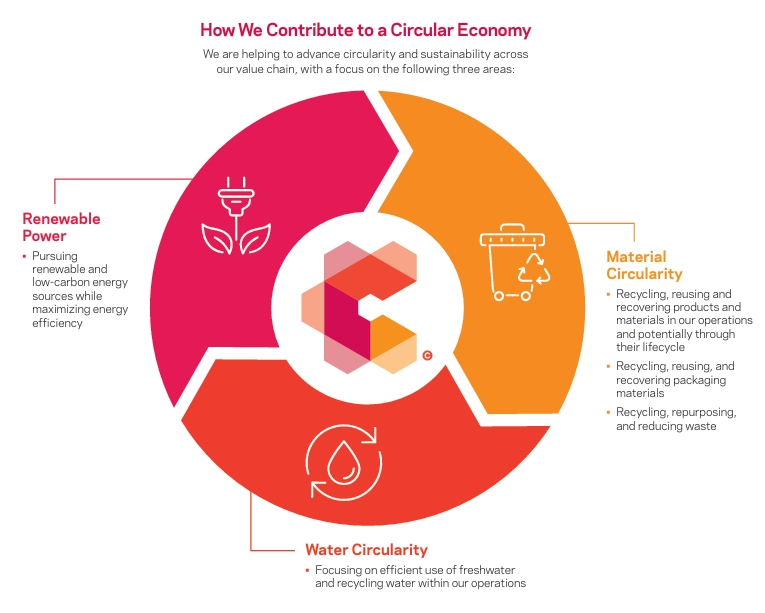
Chemours helps build a more circular economy by improving manufacturing processes that close the loop on water and waste and promoting product and packaging reuse and recycling. Our circularity aspiration is to decouple our growth from resource consumption and reduce waste by implementing circularity principles in our operations and with our partners. This aspiration is part of a broader commitment to make the most of critical resources, prevent waste, take climate action, and support a thriving society. As our understanding of circularity, product carbon footprint, and lifecycle analysis matures, we expect to see intersections between our circularity and climate goals. To ensure a positive circularity trajectory, we plan to announce specific targets and key performance indicators in future sustainability reporting.
Throughout our operations, many existing processes and practices encompass circularity principles and enable the most efficient use of resources and materials over their lifecycle. Chemours supports a circular economy through initiatives that advance safe global recovery, reclamation, and reuse of products, including refrigerants. This work also helps customers contribute to circularity by extending the lifecycle of materials and feeding them back into the value chain, which saves resources, reduces waste, and creates value for future generations.
Understanding Local Water Context
Chemours continually assesses individual watersheds in which we operate to understand the local context for water availability, quality, and use needs. Through Operations Sustainability Reviews, we assess each watershed’s concerns, including water stress considerations, and tailor actions to address internal and external stakeholder needs. In 2025, we completed assessments at one additional manufacturing site, bringing total sites assessed to 19. Overall, we’ve completed 90% of planned baseline assessments and, based on current projections, we expect to complete the remaining 10% by 2027. Following the initial assessments, we will periodically survey each site to monitor progress toward implementing identified improvements. As of year-end 2025, we’ve completed Operations Sustainability Review refresh studies at 3 manufacturing sites.
Redesigning Packaging to Reduce Waste and Emissions
Chemours’ Titanium Technologies business received the Better Practice Award from the U.S. Department of Energy’s Better Buildings, Better Plants Initiative for a new packaging innovation that saw its first full year of implementation in 2025. The business used redesigned bulk packaging for its pigment products, which involved replacing rigid cardboard inserts with internal baffles. This lighter, single-material solution reduced packaging weight by 33% and eliminated more than 130 tons of cardboard waste in 2025. The team is now looking into replicating this approach across additional packaging sizes to broaden its impact.
Pallet Refurbishment to Reduce Waste
In 2025, we expanded the pallet refurbishing program in place at our DeLisle, Mississippi facility, to our New Johnsonville, Tennessee site. Through this program, we collect and separate pallets that are damaged or soiled on site. We then return these pallets to our vendor where they are inspected, sorted, and assessed for reuse. Those suitable for refurbishment undergo cleaning and minor repairs to restore them to operational standards before they are returned to the plant to be put back into service. Those that are too damaged to be repaired are ground and sold for biofuel. By extending the lifecycle of pallets through refurbishment and reuse, this program minimizes material waste and reduces the need for new pallet production.
Assessing Circular Packaging Use
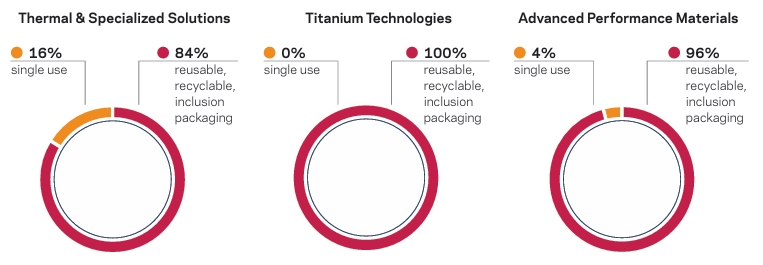
Chemours' businesses are committed to packaging solutions that are reusable and recyclable. Here’s a snapshot of their performance in 2025:
Learn more about Chemours’ actions toward supporting a circular economy in the latest Sustainability Report.
What's your opinion of Chemours after reading this?