From artificial intelligence to predictive analytics, retailers are investing in smarter supply chains. New DP World research explores the technologies driving this transformation and the challenges standing in the way.
Knowing where goods are located has long been a priority for retail supply chain leaders. But in an environment defined by constant disruption, visibility alone is no longer sufficient.
Retailers increasingly need to understand what might happen next, how disruptions could affect their operations and what actions they should take before problems escalate.
This is driving a shift from reactive supply chain management toward more predictive, technology-enabled decision-making.
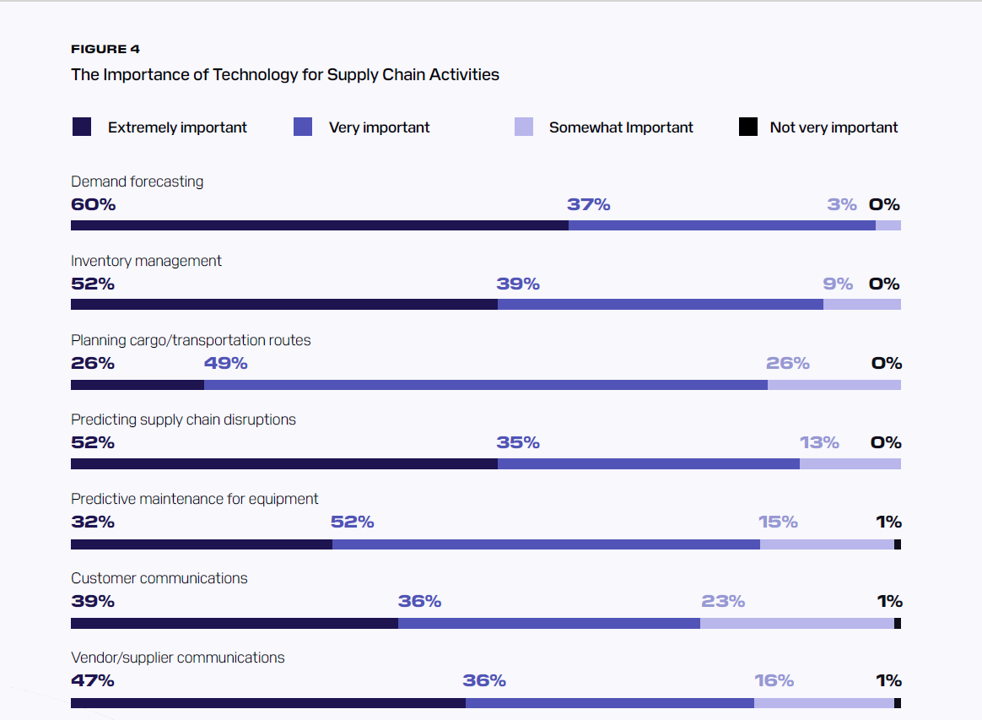
New research from DP World and Supply Chain Dive illustrates the growing importance of this transition. In the report, How Retailers Are Rewiring Supply Chains to Handle Rising Costs, Risks and Uncertainty, 97% of retail supply chain leaders surveyed said technology is extremely or very important for demand forecasting, while 91% said the same for inventory management and 87% for predicting supply chain disruptions.
The findings point to a fundamental change in the role technology plays across retail logistics.
Turning supply chain data into decisions
Retail supply chains generate enormous volumes of information across suppliers, transportation providers, warehouses and distribution networks.
The challenge is turning that information into insights that improve operational performance.
Predictive analytics, artificial intelligence and connected technologies can help retailers identify emerging risks, anticipate demand fluctuations and evaluate potential responses.
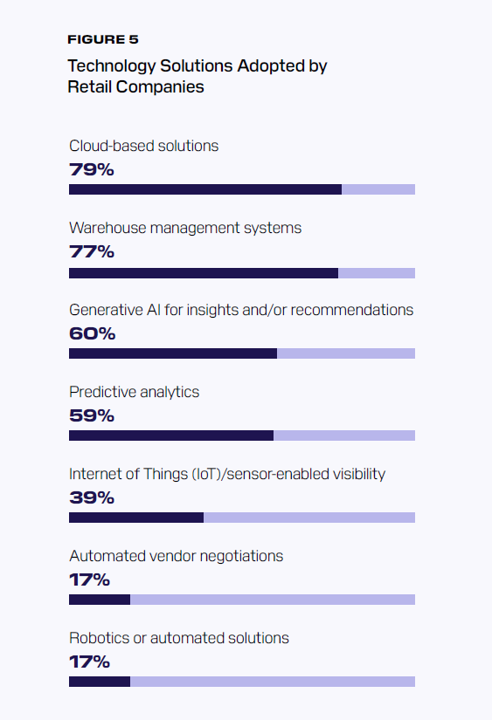
According to the DP World research, 60% of surveyed retailers have adopted generative AI for insights or recommendations, while 59% have implemented predictive analytics.
Cloud-based solutions and warehouse management systems are even more established, with adoption rates of 79% and 77%, respectively.
These investments demonstrate that digital transformation is already underway. However, adopting technology is only one part of the equation.
The greater opportunity lies in connecting systems and information across the supply chain so insights can translate into coordinated action.
The next frontier: Predictive and automated operations
Retailers are also looking beyond established technologies toward solutions that can improve operational agility.
Over the next 12 to 24 months, 31% of respondents plan new investments in robotics or automation, while 24% are targeting predictive analytics and another 24% are investing in Internet of Things technologies and sensors.
These capabilities could help retailers anticipate equipment maintenance needs, improve warehouse productivity and respond more quickly to transportation disruptions.
However, implementation remains challenging.
More than half of respondents, 54%, identified regulatory concerns as a barrier to technology adoption. Competing strategic priorities were cited by 45%, while 37% pointed to difficulties integrating new technologies with legacy systems.
These findings underscore the importance of approaching digital transformation as an operational strategy rather than simply a technology investment.
Connecting intelligence across the supply chain
Technology delivers its greatest value when information can move seamlessly between the organizations responsible for getting products to market.
A retailer may have sophisticated demand forecasting capabilities, for example, but those insights have limited operational impact if suppliers, transportation providers and distribution partners cannot respond accordingly.
This creates an important role for integrated logistics providers such as DP World, whose end-to-end capabilities can support greater coordination across interconnected supply chain activities.
The objective is not simply to provide more information, but to help organizations use that information to make better decisions.
As supply chains become more complex, retailers will increasingly be judged by their ability to anticipate challenges and respond before those challenges become costly disruptions.
The next competitive advantage in retail logistics will come not from seeing more, but from acting sooner.
Explore the technologies shaping retail supply chains
How are retailers investing in AI, predictive analytics, automation and connected technologies? And what barriers are preventing organizations from realizing their full potential?
Discover the technology adoption trends, investment priorities and operational challenges identified in DP World and Supply Chain Dive's latest retail supply chain research.
Download the full report to explore the findings and benchmark your technology strategy →
Additional Media
Images
What's your opinion of DP World after reading this?