For much of the AI boom, conversations about infrastructure have centered on chips, power and land. GPUs have dominated headlines, utilities have raced to meet unprecedented electricity demand, and developers have searched for sites with available capacity. Yet one critical factor has received far less attention: the supply chain.
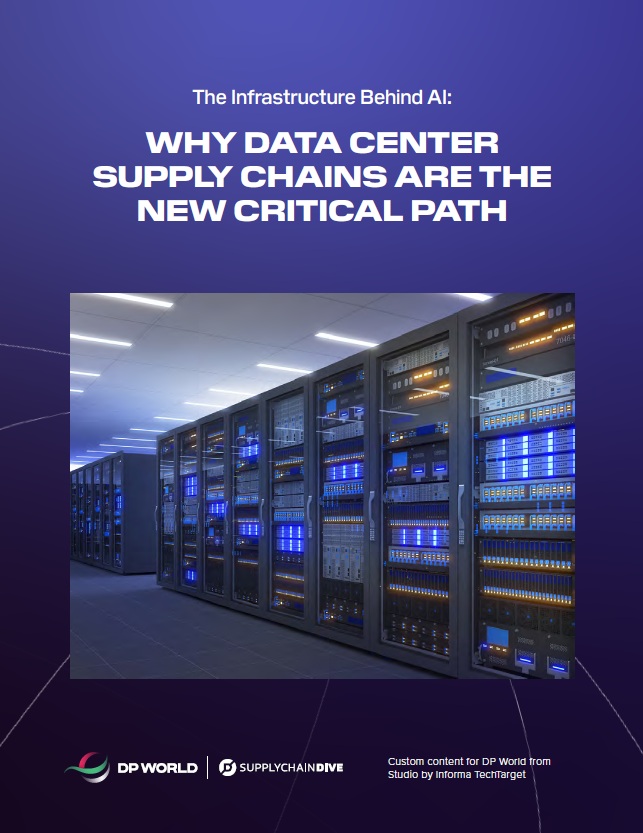
A new report from DP World and Supply Chain Dive's Studio by Informa TechTarget – The Infrastructure Behind AI: Why Data Center Supply Chains Are the New Critical Path – argues that logistics has become a defining factor in AI deployment. As global data center investment approaches $3 trillion by 2030, supply chain performance is increasingly determining how quickly new compute capacity comes online.
Unlike traditional supply chains, data center logistics involve coordinating hyperscale construction schedules with deliveries of oversized transformers, long-lead electrical equipment, high-value GPU clusters and other specialized infrastructure.
Many of these components must move across multiple countries while navigating customs requirements, regulatory compliance and tight installation windows. A delay is no longer simply an inconvenience – it can postpone AI deployment and leave significant capital sitting idle.
The report illustrates how common these disruptions have become. Nearly seven in 10 respondents (67%) reported experiencing cybersecurity-related supply chain disruptions during 2025, while 51% encountered supplier failures and 44% dealt with material shortages. Together, these findings suggest that the industry's greatest challenges extend well beyond hardware availability.
The implications are significant. Every delayed transformer can postpone site energization. Every shipment held at customs can prevent an AI cluster from becoming operational. In an environment where organizations are racing to deploy infrastructure, logistics performance increasingly translates directly into infrastructure performance.
That reality is changing how executives think about supply chains. Rather than treating logistics as a back-office function focused on procurement and transportation, organizations are recognizing it as a strategic capability that directly affects revenue generation and competitive positioning.
"As the report makes clear, supply chain strategy is infrastructure strategy," said Ya-Han Brownlee-Chen, Vice President – Data Center Strategy, DP World in the Americas. "The ability to anticipate disruption, secure critical components and maintain end-to-end visibility will determine how quickly organizations can deploy compute capacity and scale for future demand."
The report also highlights the specialized nature of modern data center logistics. Secure chain-of-custody procedures, white-glove handling, real-time shipment visibility and synchronized delivery schedules have become essential components of successful deployments rather than premium services.
As AI adoption accelerates, organizations that can move infrastructure efficiently may gain as much competitive advantage as those that secure the latest chips. The race to build AI infrastructure is no longer determined solely by what companies can buy. It is increasingly determined by how effectively they can deliver, protect and install it.
In the AI economy, logistics is no longer supporting infrastructure – it has become infrastructure.
Download The Infrastructure Behind AI: Why Data Center Supply Chains Are the New Critical Path.
Additional Media
Images